In the period of history leading up to the French Revolution, the Rococo period had superseded the Baroque era and replaced it's darker themes with intricacies, ornamentation and decoration, with the work Rococo meaning "shell work". It focused on beauty and the motif. Being an exclusive art period to the French court, it catered only for aristocracy and was just another example of how the Bourgeoisie became more and more detached from the people as their wealth was put on exhibition through art, particularly attached to the reign of Louis XV.

Features of Rococo art

In the Rococo period, painting was delicate and finely detailed, which would later become criticized despite it's intricate curvilinear shapes and perfect finishing, complete with rich and luxurious fabrics and beautiful backgrounds. In a way, this was the complete opposite of what the Baroque artists were attempting to achieve. However, the marks of a rococo painting are shown in soft brush strokes, reflective of the wealth and royalty of French court.

Key Artists

Jean-Honore Fragonard is an example of an artist that would paint the high society of the French court, his most famous work being The Swing (Les hasards heureux de l'escarpolette) painted in 1767 using Oil on Canvas which made him popular with the aristocrats of the court. His figures are prominent in their rosy cheeks, exposed body and 'passionate' embraces as shown in The Swing. This painting shows the lifestyle in which they live, the girl is being pushed on the swing by her husband while her husband sits in front looking up her skirt.
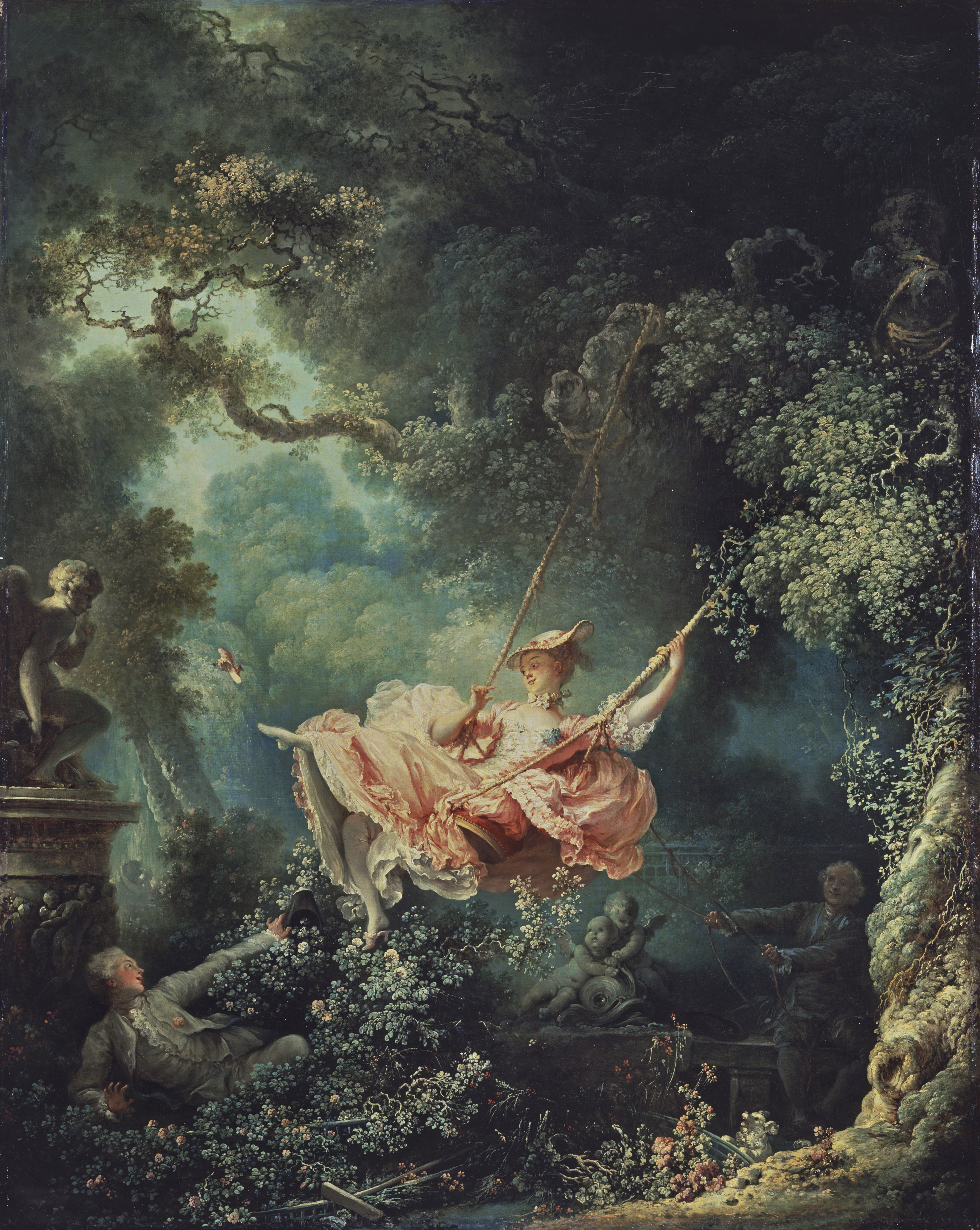
"The Swing" by Jean-Honore Fragonard, Oil on
Canvas, finished in 1767.
William Hogarth

From the Rococo period, William Hogarth became a vital name for his crucial theory on the 'Serpentine Line'. In the William Hogarth book, "The Analysis of Beauty" from 1753. In the book, he describes how the way to fix art would be to stop the "fluctuating ideas on taste". He claimed that the Serpentine Line was of optimum beauty, with nature's observation being the "cornerstone of artistic practice". We should be pleasuring the eye with a sense of variety according to Hogarth. 

How did the Rococo period end?

The French Revolution effectively ended the French rule of Louis XVI and the political climate that Rococo art revolved around. The end of this rule was brought about by revolts that effectively ended the French monarchy and put Napoleon in place. This period of art was quickly marginalized, claimed to be far too based on ornamentation and wealth, very simple and sentimental themes. The art that would later become favoured would be the styles of Neoclassicism and the art that came out of the Age of Enlightenment. Some writers and critics, such as Voltaire, also regarded the period of art as being too superficial and later becoming "degenerate". Neoclassicism would be what replaced Rococo art in France.

"Simplicity" by Jean-Baptiste Greuze (c. 1759).

The degenerative qualities of the Rococo period as seen in the later half of the 18th Century are illustrated in the image above, "Simplicity" by Jean-Baptiste Greuze, painted in 1759. The images theme is purely sentimental and is based on it's emotional value of the young girl rather than the higher regarded portraits of aristocrats such as Madame de Pompadour earlier in the period. The work is vey soft and plain, generating very little interest. Greuze himself has often been accused as an artist of overt emotion, unnatural and poor composition and unattractive colour schemes and palettes.

Ultimately, the Rococo art period of history is one that is closely tied with the society of the time and the political climate, influencing the artwork directly. It's themes do not often differ from the subject matters of wealth, luxury, status, sexuality etc. all aspects of French life being exploited in the court by Louis XV and the monarchy itself. It's criticisms as a movement of art are more wide ranging than most throughout history, from the twisted portrayal of emotion, the lack of dynamic in subject matter and the degeneracy and overall decorative qualities that were later rejected after the French Revolution in 1789 to 1799.


After the rejection of the Rococo period, Neoclassicism aspired to restore the order of Apollonian art and style, marking a return to the ideas and forms found from the Renaissance period, but more importantly, looking back to the classic ideas and themes of painting depicted particularly in Roman Art. This aimed also return to the artistic standards of the ancient world. It's most highly regarded painter is often named as Jacques Louis David, who used ancient scenes as an allegory for contemporary issues.

However, in the 20th and 21st Century, this period of art history is often noted as dull and repetitive, regurgitating the same themes, ideas and compositions without any accompanying fresh ones. This meant that for the most part, this was a familiar form of art that we have seen revived multiple times during history. The Neoclassicists desired to return to the 'pure' art of Rome.

 The Return to the Classic

The majority of neoclassical works are conducted in the media of painting. These paintings would feature the biblical or mythological scenes found from the Ancient civilization. The painting below, The Oath of the Horatii by Jacques Louis David in 1784 is an extraordinarily large painting standing at 3.30 by 4.25 metres. The painting itself aims to depict heroism, revolution and empire as used by the rebels during the French Revolution, despite the painting being commissioned by Louis XVI, Jacques Louis David's work was used for an ulterior purpose.

"The Oath of Horatii" by Jacques Louis David, painted Oil on Canvas, (c. 1784).

In the above painting, links to Classic civilization can be deduced, such as the Roman armour and clothing, involving togas, helmets and swords, the striking shadows casting a difference between the soldiers and the women and children behind, the return of the rich red colour alludes to power, passion and the air of revolution.

Jacques Louis David

(1748 - 1825) David was heavily inspired by politics and was often commissioned to create paintings as an early form of what we would now call propaganda, often providing a commentary on the French Revolution and the rule of Napoleon and the French Empire. His paintings are often deemed to be heroic and dramatic in their emotion, scenes are not subtle or understated but bold. Other works by Jacques Louis David include, The Death of Socrates (1787) and Madame Recamier (1800), mostly working with the media of chalks, drawing and oil painting.

Neoclassical Sculpture

Antonio Canova (1757 - 1822) was a pioneer and the leading participant in the sculpture of the Neoclassical era. He was highly praised as having introduced the revival of sculpture in art since the Renaissance which had largely been abandoned in the Baroque and Rococo period due to the prevalence of the growing art of oil painting, which meant that sculpture had essentially become a "lost art". Neoclassicism was the first period of art to reintroduce this form of media.
Antonio Canova's "Paolina Borghese as Venus Victrix" c. 1805 - 1807
In a similar way to oil and easel paintings during the Renaissance, sculpture had now also become independent from it's environment and was no longer a simple fixture to an architectural design. This meant that sculpture, particularly that of the feminine form, became constructed for art's sake. Another famous work of Antonio Canova was Cupid and Psyche (1796 - 1797) at a height of 150 centimetres, built from marble. This work displays how the sculptor had an obsession for certain areas of the body that others avoided, e.g. hands and fingers.

Key Artists

At this point in time, landscape artistry had become of vital importance. Claude-Joseph Vernet is an example of a painter of beautifully composed Italian landscapes. He often looked at the water, whether it was shipwrecks, ports or coastlines. A typical work of Vernet is The Shipwreck painted by the French painter in around 1772. This is another instance that a relatively contemporary notion or event has been represented allegorically by the painter in order to link back to a biblical or mythological scene, much relevant in the Neoclassic era. The painting is dark in it's colour scheme, with heroic figures saving others from the wreckage, while the sky's background is lit up in places. Critics and contemporaries alike praised Vernet as an inclusive painter, allowing the audience to feel as though they themselves are in the stormy painting.

"The Shipwreck" by Claude-Joseph Vernet, Oil on Canvas, 1772.

Another noteworthy artist of the period was female oil painter, Elisabeth Vigee Lebrun, A member of the French Academy, it was still rare for a female artist to become prominent, however, her painting was reminiscent in aspect of Rococo art, showing surprising similarities due to her being an artist previously under the ancien regime. The similarities lying in the depiction of women's fashion, emotive facial expression, with rich and luxurious colours.
File:Élisabeth-Louise Vigée-Le Brun - Madame Molé-Reymond (1786).jpg
"Portrait of Madame Mole-Reymond" by Elisabeth
Vigee-Lebrun, painted with oil on panel in 1786.
In conclusion, artists of Neoclassicism looked for a return to the "purity" of classic art and it's Apollonian qualities of order, beauty, strength etc. This is a more imperial view on art, adopting the values of both the Ancient Classics and the resurgence during the Renaissance. Qualities admired in Neoclassicism are the heroism, the idealism and power held within the artworks and the narratives they offer. The Neoclassicism era was later superseded by the period named Romanticism. 
In the 19th Century, following on from the Age of Enlightenment of the 18th Century and branching off from Neoclassicism, was the negative reaction to the new developments in science and the effects that the Age of Reason had upon society. Instead of exploring the new themes that looked away from religion to a whole world of new ideas, it looked inward and exploited emotion as a new type of aesthetic, differing throughout the art period in emotions - horror, trepidation and awe, often using these emotions to display their aversion to the Age of Enlightenment. The basic principle of Romanticism was a fusion of natural phenomena and the range of human emotion, looking for an Apollonian sense of subject matter.

Key artists of the period are widely known, ranging from greats such as Francisco Goya to Jean-Auguste-Dominique Ingres, from Eugene Delacroix to Caspar David Friedrich and even John Constable.

Characteristics of Romanticism

Romanticism exclusively explores personal experience and is based on the artists imagination and own emotion. As German painter, Caspar David Friedrich has explained "the artist's feeling is his law." This gave artists a free reign over the subject matter and emotive qualities of their work, whether it achieves wonder, fear, sadness or any other feeling. It was also considered to be vital that every work was unique to itself, this is something that only the best Romanticist painters could provide.

Despite not being fundamental, nature was a key aspect of the paintings, often as a portrait that features a single figure, being affected by their landscape. It was believed that humans needed to maintain a strong connection with nature rather than immersing themselves in the scientific human world. A key artist that achieved this style was Caspar David Friedrich and Wanderer above the Sea of Fog, a painting from 1818 which encapsulates the idea of that human connection with natural phenomena, the figure in the image standing on a mountain's edge looking out over the blanket of fog covering the scene. Although the man's back is turned to the audience, the painting is emotive as it's evident that the character is contemplating his own life and death, looking to the root of Romanticism.

Caspar David Friedrich - Wanderer above the sea of fog.jpg
"Wanderer above the Sea of Fog" by Caspar David
Friedrich, painted in 1818.
Key Artists

Joseph Mallord William Turner is often considered to be extremely influential of Impressionist art, but initially worked in the confines of Romantic art, an artist that truly put himself inside the scenes he created. For the creation of the painting Snow Storm - Steam Boat off the Harbour's Mouth in 1842, Turner even went to the extent of tying himself to the mast of a ship in order to get the experience first hand of the elements of weather and the feeling he was trying to formulate in the painting. One of the more chaotic paintings of Turner's career, the image captured a great deal of emotion and movement despite their being no human figures present in the painting.

Joseph Mallord William Turner ‘Snow Storm - Steam-Boat off a Harbour’s Mouth’, exhibited 1842
"Snow Storm - Steam Boat off the Harbour's Mouth", painted in 1818 by
Joseph Mallord William Turner from a first hand experience of the subject.

Turner and others led to the flourishing of landscape artists in the 19th Century, particularly the work of fellow influential painter John Constable. Constable's landscapes were heavily based on the perspective of nature followed by Romanticists. As an artist, John Constable believed that the aspects of nature; trees, rivers and streams, sunlight and shadow etc. was able to allude to spiritual goodness, creating that connection between us and nature once again. His most famous painting, The Hay Wain painted in 1821 with oil on canvas. As the perspective and emotion of the artist is always law, it was a painting that connected to Constables childhood as the son of a miller and the memory he had of this time. The image puts together so many small components to gain a sense of lifestyle and emotion with clarity. 

"The Hay Wain" by John Constable, painted from overlaid sketches and
oil on canvas, 1821.

Francisco Goya

The mediums used by Francisco Goya were wide ranging, from drawings to engravings and to wall paintings. Themes ranged from portrait to commissioned political artworks with a purpose. One of his most famous artworks is The Third of May, 1808 painted and exhibited in 1814. The image depicts Napoleon's army during the Franco-Spanish War as they execute around a thousand villagers in Madrid in revenge for a rebel attack. His artworks are high emotive, with a sense of horror to establish a feeling on a political or war theme.
goya third of may
"The Third of May, 1808" painted by oil on canvas and exhibited in 1814 by
Francisco Goya.
Goya has also produced many other less well known works which are emotionally and politically motivated with a romantic tone. Goya's etchings and aquatint were extremely relevant, originally commissioned for Spanish court artworks, his own personal work gave way for him to express more of his own views, e.g. The Disasters of War (1810 - 1820) as he recorded his own imaginings of the Napoleon invasion of Spain in 1808 and it's atrocities, barbarism and heroism. 

"The Disasters of War", an etching of a series by Francisco Goya, (1810 - 1820)
The etchings are one of the fewer examples of how the emotion of horror can be depicted in Romanticism, it relies on a very different kind of media to other artists during this period, making Goya stand out as one of the best and most important artists of the 19th Century.

Ultimately, Romanticism as an art movement that is a rejection of anything discovered in the Age of Enlightenment, furthered by landscape artists such as John Constable and J.M.W. Turner as well as other artists including Francisco Goya, Caspar David Friedrich, Eugene Delacroix etc. It sees the beginning of the celebrated relationship between human nature and emotion and nature of the world around us, often resulting in idealistic imagery of an Apollonian nature or Dionysian disorder, war etc.

Academic Art was the period in history in which official institutions were set up in order to both teach and exhibit art that was favoured by the schools for using the techniques and processes celebrated by such Academies. In the 19th Century, institutions such as The Paris Salon, the Academie des Beaux-Arts set up in 1725 were the hub for Academic Art in Europe up until the 1890's. In 1863, the Salon des Refuses was the institution set up as a reaction to the work that was rejected from the Paris Salon, exhibiting the more unconventional and controversial side of the art period.

The introduction of Academic art meant that art was now made into an industry itself, with exhibition of art really beginning to take off, this meant that prospective artists were submitting their with the purpose of recognition and criticism. This changed the landscape of European art up until the current day, changing the way in which art became accessible to the public eye. However, Academic Art is largely known for the masterpieces it rejected, with these artworks being the most famous now, rather than artworks the Salon accepted.

Characteristics of Academic Art

Characteristics of Academic art and therefore taught by the Parisian schools which lie within the mediums of sculpture and oil paintings. all of which looking to portray technical and intellectual skills, an Apollonian ideal. They all displayed ideas and subject matter that spanned through Neoclassicism, Romanticism and later on, Impressionism. These qualities can be found in the work of artists such as Paul Delaroche and Thomas Couture.


"The Execution of Lady Jane Grey" by Paul Delaroche, painted in 1833 using
Oil on Canvas.
The painting above, by painter Paul Delaroche, as common to the period, depicts a historical scene of the beheading of Lady Jane Grey, a well known point in history. It also appears to focus on the Romanticism of the scene, focusing on the figures around her rather than on Lady Jane Grey herself, paying attention to their emotions. It shows very technical skills and abilities in it's painting and has been a major exhibit at the Salon.

The Paris Salon

The Parisian Salon was an art exhibition space, opened in 1677, becoming particularly popular in the 19th Century. The space was reserved for students of the Academie des Beaux-Arts, with artworks judged and qualified for the exhibition based on their skills.

A major quality of The Salon that made it recognized and distinguishable from modern day art galleries is the sheer mass of artworks it exhibited, the walls of it's rooms were filled inch-by-inch with students paintings, from floor to ceiling. The Paris Salon was filled with artworks such as Thomas Couture's The Romans of The Decadence from 1847 and William Adolphe Bouguereau's Birth of Venus from 1879.
William Adolphe Bouguereau's "The Birth of Venus",
painted by oil on canvas, 1879.
"The Birth of Venus" as painted by Sandro Botticelli,
1486.
The image above, Bouguereau's Birth of Venus, painted in 1879, is an example of how the students at the Salon would look back to previous artworks from more Apollonian art periods, such as the Renaissance, and imitate or even copy the subject matter or techniques by applying their own techniques. For instance, Bouguereau's own rendition of the Birth of Venus is an imitation of the painting of the same name by Sandro Botticelli. When compared, it can be noticed that the image on the left, from the Academic period, is painted with thicker brushstrokes, using impasto technique, it is more realist in it's painting and focuses more on skills than the subject matter. The Renaissance painting on the right, however, is more stylized and painted with the mythology in mind. 

Royal Academy of Arts

Founded by Joshua Reynolds, under King George III, the Royal Academy of Arts, London is an art school built in 1768 in hopes of promoting the cause of professionalism in the arts and design industry. The image below, taken in the 21st Century shows how popular the galleries at the Royal Academy still are. Similarly to the Paris Salon, paintings still cover a large proportion of the wall space. 
Galleries at the Royal Academy of Art, London for the 2011 Summer Exhibition.
Johann Zoffany's "The Academicians of the Royal Academy" (1771 - 1772).
The image above gives us an insight of the studios of the Royal Academy, showing the room filled with people and two life models to the right, it bares some similarities to art schools in the 21st Century even, showing the model at which art schools following on from this were built upon. The painting itself is constructed in the way of much Academic art, showing how sculpture was included in Academic art as students started to learn to paint their own surroundings.

The Salon des Refuses

Many artworks were rejected by the Paris Salon, much of these were turned away due to their unconventional techniques or subject matter. Many of the rejected works were then found by an establishment built in reaction to the Salon's system, named the Salon des Refuses. The Salon des Refuses was constructed in 1863 after many artworks that year had not been exhibited.

Edouard Manet - Luncheon on the Grass - Google Art Project.jpg
"The Luncheon on the Grass" by Edouard Manet from 1863's Salon des Refuses.
The image above, The Luncheon on the Grass by Edouard Manet was a key image in the Salon des Refuses existence. It was an image based on a painting by an Old Master, but it's subject matter was considered unacceptable by the Salon. This was the reason for the Salon des Refuses. The casual nude female form was too controversial while painting men fully dressed. There was a similar negative reaction to Olympia, painted in 1863. This painting was thought to include a reclining nude of a prostitute with a black woman as a maid, this was thought to also be unsavory and was subsequently added to the Salon des Refuses.

Other Key Artists

Other artists included in the Academic era of art attended a variety of high profile art schools, with many people migrating across Europe and from beyond. One of these artists is Frederic Edwin Church. Church has been considered to be one of the greatest American landscape painters in history. His observations for such landscape paintings took him to both the North and South Americas to record natural phenomena in a Romanticist style. Using a new elevated viewpoint and distant horizon, he was a major figure that attended the Hudson River school for landscape painting. One of his most important works was Aurora Borealis painted in 1865, depicting the Northern Lights phenomena with an observation close to photo-realism, paying close attention to light and tonal value.
Aurora Borealis by Frederic Edwin Church
"Aurora Borealis" by Frederic Edwin Church, painted with Oil on Canvas in 1865.
Another important artist during this period was another American artist, Thomas Cole. The founder of the same school as Church, Cole taught at the Hudson River School. Cole was conservative in his understanding of Academic art and Romantic in his painting style. His landscape painting was mixed with a subject matter that overlapped with mythology and biblical ideas. 

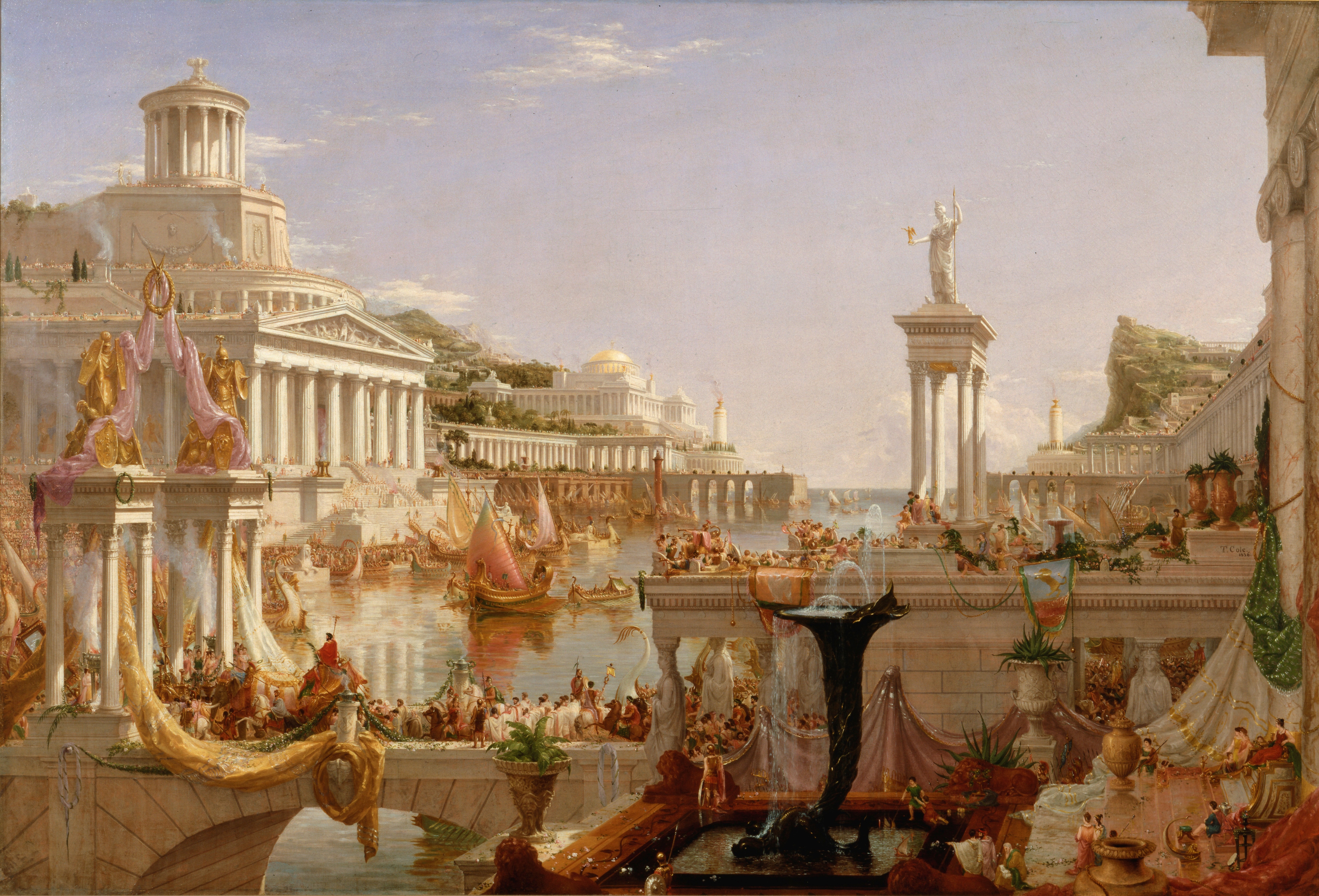
"The Course of Empire" by Thomas Cole, 1836, painted by Oil on Canvas.

The Course of Empire by Thomas Cole symbolises the way in which Academic Art was still stuck in the past, imitating the art and landscapes of the Greek Empire and other historical scenes.

To conclude, Academic art is a culmination of the past and skills acquired from traditional means of oil painting, brush marks, perspective etc. The field of Academic art in history proves the competitiveness that is rife in the European art world, however, despite institutions such as the Royal Academy, the Hudson River School and the Salon, it is it's reactionary movement found in the Salon des Refuses that defines the 19th Century of art, through it's ground breaking subject matter. This put artists such as Manet on the map and changing the way we move through art history.


Realism left behind the Apollonian idealistic confines of art making in order to document real ideas, real issues and often depicted the subject matter that we didn't want to see. The themes of realist art explored a range of topics, from prostitution to death, to poverty and peasants. This can be seen as another extension of the movement that was started by artists such as Manet exhibiting artworks at the Salon des Refuses and painting subject matter that did not conform to the status quo, venturing further into the Dionysian ideas.

Artists that need to be visited when looking into realism are some of the most important artists of all time include Jean-Baptiste-Camille Corot, Edouard Manet, Gustave Courbet and Auguste Rodin.

Background

The concept of realism is often reasoned as a social and political ideology, associating itself with telling the truth of reality rather than the more imaginative themes throughout history featuring idealistic forms and scenes, rejecting the former themes of Academic art also, believing it to be hypocritical, repetitive and too utopian. Realism in art tends to come as a partner with it's political agenda of hoping to further social change, aiming for; a new democratic system, focusing on human rights e.g. labour, poverty etc. This often provides a basis for the subject matter of realist art.

The Gleaners - Jean-Francois Millet
"The Gleaners" by Jean-Francois Millet, complete in 1857 with Oil on Canvas.

The image above, The Gleaners is the ultimate depiction of what Realism tried to expose people to the truth of. The image of workers in a field, clearly living in poverty with poor labour conditions, it aimed to give an emotional window into these people's lives. This is evident through the actual way in which it has been painted, as realistic and possible considering the materials and techniques of the time. It is also evident through the smaller details, the gathering of wheat, the torn and dirtied clothes and the land use. This painting contains everything that the Realist period tried to portray to the audience, showing that this was the first art movement that pushed for a social agenda.

Gustave Courbet

A French painter, Courbet despised the Academy and it's outdated traditions, pushing more than any other artist for the development and spread of realism. Using the classic oil paints on canvas, his works had a seemingly ongoing theme of poverty or desperation, resulting in a strong emotive response from the audience. His artworks range from the tough and demanding everyday labour carried out by ordinary people to the nature of forests and seas. He had the ability to add the essence of realism to any painting with thick, sweeping brushstrokes upon large canvases. Courbet was known to work within a broad spectrum. Such work is evident in Self Portrait (The Desperate Man) painted in 1845, as you can sense the desperation and movement in the image by the close up facial expression, gaining an insight of his observation rather than imagination, you get the sense of reality. 

"Self Portrait (The Desperate Man)" by Gustave Courbet, 1845, Oil on Canvas.
Edouard Manet

Manet was another French painter, known for his role in the movement from Realism to Impressionism. However, the painter's aspiration was to achieve the greatness of the Old Masters. Considered to have a tremendous talent for the avant-garde subject matter of urban life and "watershed paintings", he was only rejected as he did not conform to the ideals of Academic art, and later on his realist work caused a mental breakdown in the year 1871. Francisco Goya's Romanticism is named as an influence on his personalized styling of using flat plains of colour with sketch like painted line. One of his most famous artworks is The Bar at the Folies-Bergere painted in 1882. It's painting was typical of Manet in it's utilization of the finer details, using a mirror in the background behind the barmaid to emphasise the inequality and "brushing shoulders" of the upper-class and the poverty stricken staff and prostitutes in the bar, indicating the fine line and the perspective of the working class.

Edouard Manet, A Bar at the Folies-Bergère.jpg
"The Bar at the Folies-Bergere" by Edouard Manet, painted 1881 - 1882.
Jean-Francois Millet

Another important artist of the Realist art movement was Millet, a French oil painter specializing in engravings. Growing up as the son of a French rural farmer, Millet understood the lifestyle of the social classes often featured in Realist artworks. For this reason, when industrialisation began in France and the peripheral farming industry began to dwindle, he began painting the disadvantaged lives of the hard working people in these fields. Depending on the side at which the audience looks at the painting from, it is said that the workers can be depicting the dignity of the work they do, or the cruelty that they endure. 

An artwork that illustrates this feeling is The Angelus, completed around 1859, which depicts two figures praying as the sun sets, while the bell tolls to end the work for the day. The image was later reproduced in a surrealist quality by Salvador Dali, however, it's message is clearly the presentation of the poor life of peasants. As the image darkens and the workers look defeated, it triggers an emotive reaction.

"The Angelus" by Jean-Francois Millet, completed in 1859.

Realism, as an art movement, was the first art movement that completely allowed itself to appear as Dionysian, illustrating the real lives of some in the world; the lives of beggars, prostitutes, peasants and workers. The paintings are still extremely emotive and are aimed at making the audience feel something in order to expose the truth and instigate a social reform. The work of realist painters was more involved in the scenes in which they painted as they attempted to untangle and simplify the issues and cruelty some people live under through artistic expression.


Impressionism is considered to be the art movement that revolutionized painting in recent centuries, modernizing it in a way that meant it could translate into the 20th Century and beyond. It threw away the rules of traditional art and became instrumental to the art of the late 19th Century in regards to it's trend of painting scenes of everyday life and the new way it played with light and use of colours and tone. This changed the tone of art and opened it up to a fresh narrative. 

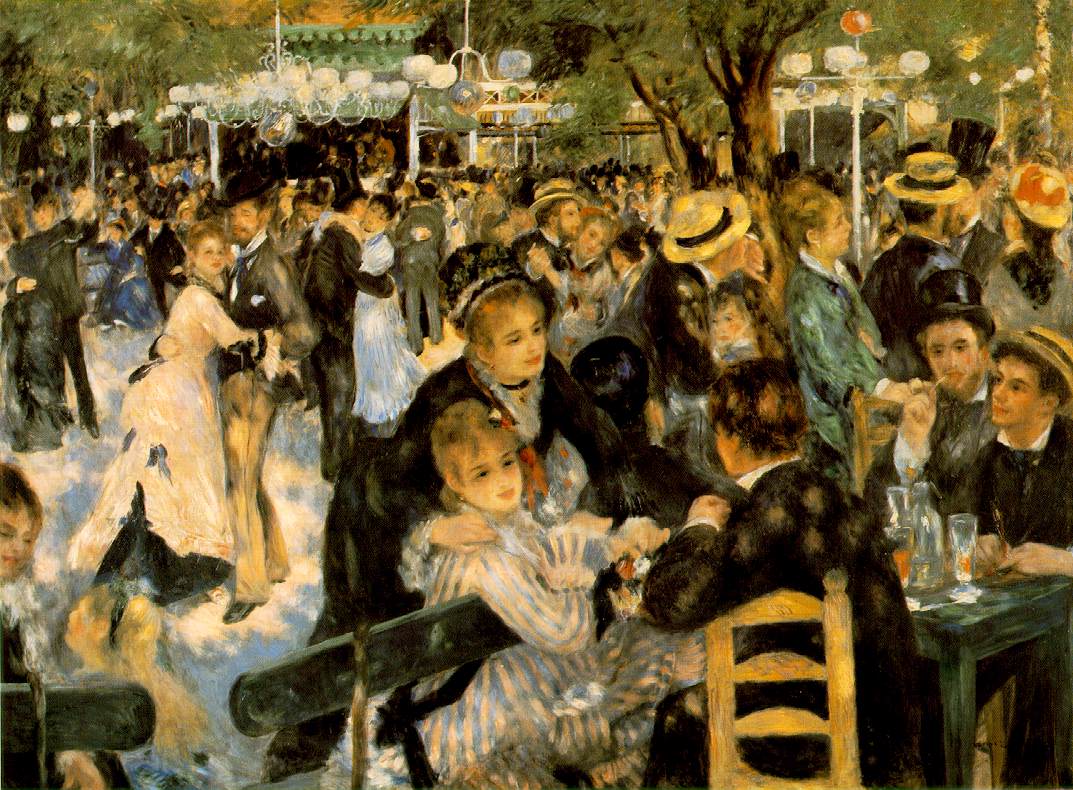
The basis for Impressionist art is considered to be contemporary life in an objective manner, describing colour as created by light and being subject to "constant change". Artists that were vital to the direction of this art movement include Claude Monet, Camille Pissarro, Edgar Degas and Pierre-Auguste Renoir. These artists shaped the modern way we paint today and the way in which we use paint and create brush marks.

"La Moulin de la Galette" by Pierre-Auguste Renoir, painted in 1876 using
Oil on Canvas.
Subject Matter

Impressionism sought to capture the very moment of observation, as if a snapshot is taken in time for a truly ordinary and contemporary scene; these scenes included parties, landscapes, railway stations and other aspects of life. 

An important component of the subject matter of the Impressionist era, was that paintings would be completed almost entirely from observation, meaning that some had to be painted plein-air, indicating that a painting was completed outside in the open air. This meant not only that the painting would be influenced by the outdoors, e.g. damaged, dusted with sand but that they would have only a limited amount of time to be painted often appearing as unfinished.

"The Beach at Trouville" painted by Claude Monet, 1870.
The Beach at Trouville series by Impressionist painter Claude Monet is an example of an artist working en-plein air, evidenced by the fact that there was sand dusted in the layers of paint, uniquely changing it's texture. It can be deduced by the qualities of the painting such as quick brush strokes, thick layering of paint and slightly abstract line that the painting was quickly sketched and completed, with a focus on the light rather than perfecting other skills.

Unusual Viewpoints

The artist Claude Monet in particular was one to paint an image from an alternate viewpoint, even purchasing a boat in order to sail down the river while painting the riverbank's scenery. The painting was named Autumn Effect at Argenteuil in 1872. While this image was painted, Edouard Manet painted the fellow Impressionist's environment as he painted the image. This artwork was named Claude Monet working on his Boat in Argenteuil, painted in 1874. Unusual viewpoints allowed a new avenue of perspective. 

"Claude Monet working on his Boat in Argenteuil" by Edouard Manet, painted
in 1874.
The image above, painted of Claude Monet, illustrates how the artist would observe a landscape and translate it onto a canvas. In this instance, Monet is seated on a boat, with a viewpoint from the water to the bank. The movement of the boat makes specific requirements of the painting; the brushstrokes and lines must be made fast and the painter must be able to depict the changing qualities of light, combining the images he sees.

Visible Brush Strokes

The texture of a painting was largely important, partially by circumstance and partly by choice. Think painterly brush strokes were incidental as they were a product of applying paint quickly to the surface of the canvas, but also necessary as the thick application of oils was a preference of Impressionist painters in the attempt to create light through a multitude of colours. 

An example of such a painting San Giorgio Maggiore at Dusk painted by Claude Monet in 1908. It shows the short, distinct brush marks that were a signature of the Impressionist period. The artist also uses these interwoven brush marks to mix colours and give that quality of changing light. 

"San Giorgio Maggoire at Dusk", painted by Claude Monet in 1908.

Prismatic Colours

Prismatic Colours, when applied to the art of Impressionism, refers to the mixing of coloured paints when the two paints are placed side-by-side upon the canvas. When the two colours appear to mix, they appear to the eye to be making a new colour, despite the artist making the attempt not to blend the two colours beforehand.

One of the most well known paintings that uses this method of mixing basic colours placed side by side is Claude Monet's Rue Montorgueil, Paris, Festival of June 30, painted in 1878. In this painting it can be seen as similar to an optical illusion in the sense that the colours blend and mix with almost a 3D quality just by being placed at such a close proximity to one other. This means that there is a shift in the way that light is represented in Impressionist painting.
File:Monet-montorgueil.JPG
Claude Monet's "Rue Montorgueil, Paris, Festival
of June 30, 1878" painted by oil on canvas.
Shade and Use of Grey Tones

To Impressionist artists, the use of black paint is of limits. Black is not a considered a colour that is found everyday, and stops an artist from being able to represent light as the existence of black is only possible where light is absent. In works of 'Pure Impressionism' the use of black was ultimately avoided, while complementary colour and greying tones would be used to represent this absence of light and shadow. 

Once again, Claude Monet's work gives the best examples of the use of grey rather than black tones in paint, with complementary colours creating dull tones, celebrating the idea of the ever changing qualities of light. Specifically, The Gare St-Lazare, painted in 1877, depicting a train at a French Railway Station. The dark tones are easy to come by, which Monet represents, but does not let this be depicted with the absence of light in places, often using shades of blue to portray the body of the train and lighter blues for the smoke and shadows inside the station. 

"The Gare St-Lazare" station painted by Claude Monet series, 1877.
Open Composition

An open composition, as easily emphasised by Edgar Degas than by any other artist of the Impressionist period. This took inspiration from early photography as it would cut off a composition from the canvas while alluding to more beyond the limits of the canvas. 

For instance, Place de la Concorde, a painting by Edgar Degas in 1875 has figures that extend beyond the canvas, so it cannot be seen fully. However, not completely obscured by the canvas, Degas achieves a photography-like quality in his compositions.

"Place de la Concorde" painted by Edgar Degas in 1875 in Oil on Canvas.
The Father of Impressionism - Camille Pissarro

A Danish-French Impressionist, Camille Pissarro is considered to be both the pioneer and the Father of Impressionism. Beginning in 1855 under the study of the masters of Realism, he developed his skills under such artists as Corot and Courbet. Common themes explored by Pissarro include scenes of true French life, of both the urban and the rural regions, particularly Montmartre and Pontoise. However, much of his more personal work was more politically motivated in a similar way to the realist masters, revealing his communist beliefs. 
"Boulevard Montmartre at Night" by Camille Pissarro, painted in 1897.
The image above emphasises the qualities of Impressionist painting that were key to it's existence, playing specifically with the element of light by using warm and cold colours intermingled to give a blended sense of light indicative of urban life in Montmartre. The artist also uses some of the thickest and distinct brush marks of any painter in the period, giving off a slight quality not very different from pointillism, another aspect of Impressionism explored by artists such as Seurat and Signac.

Ultimately, Impressionism is the art movement that allowed modern painting to become the concept that it is today. It promoted new idea; artists beginning to paint in the open air, being situated in increasingly unusual viewpoints, while constantly maintaining a speed of painting that used the changing light to their advantage. The use of light and the way in which colour created such tricks to they eye is emphasized by the first creation of Chevreul's Colour Wheel, looking at complementary colours. Key artists include Edgar Degas, Claude Monet, Camille Pissarro and Edouard Manet.


In the late 19th Century, after the Japanese reopened their borders to Western trade in the year 1854, Japanese art streamed into the European ports, opening our eyes for the first time to the parallel art movements to our own in Asia. Not only did we now have Japanese art in our possession in Europe, but the woodcut prints, the illustrations and fashions had influenced European artists such as Claude Monet and Vincent Van Gogh to embrace the new culture of ideas.

Much of the art was originated by the ukiyo-e school of art, which offered a transition period of Impressionism which would eventually morph into the decorative qualities and artistry of Japonisme.

Characteristics

The prominent characteristics of the paintings of those Impressionist artists influenced by Japanese art include a more elongated pictorial forms and an asymmetrical composition. Both of these complex painting styles have been illustrated by Edgar Degas. The clever way in which his artworks such as Dancers in the Rehearsal Room with a Double Bass (1885) and The Dance Class and The Star (1884) experiment with perspective twists and spins the perspective of the viewer over the artwork and once again, furthering the ideas of Impressionism to the point of extending the scene into the canvas.
"The Star" by Edgar Degas, painted in 1884.
The image above distorts and twists the view of the audience as previously described. This is due to the influence of Japan and the way it changed and developed styles that Degas had already adopted, changing the perspective and the more abstract quality of the painting as the view feels a greater sense of movement. The root of such inspiration for this style can be seen in some of the below examples of design in Japonisme.

Decorative Motif and Ornamentation

One of the most design based art movements we have seen as early as the 19th Century, Japonisme takes a particular focus on decorative motif, often looking at nature and aesthetics popular in Japan, giving Europe an insight into the art that had flooded it's shores from across the world. 
"Egret and Willow" by Suzuki Kiitsu, a two fold screen made of silk
on cotton.
The two fold screen above shows not only how Japonisme developed the relationship between art and interiors, but it explores the ideas of print based motifs for the first time. Illustrating an egret and willow tree, we get the designs of Japanese art but with a function or purpose. The stylization of such decorative motifs is unique to Japanese art. With the image below, we can see how this emphasis on the motif was celebrated by European artists such as Claude Monet, who painted La Japonaise in 1876 in honour of the fashions and textiles used in Japan, using the natural prints and silk materials not only made for the Kimono, but for the fans in the background, this shows the merging of cultures.

"La Japonaise" as painted by Claude Monet by Oil on Canvas (1876).
Woodblock Prints

Techniques of printmaking really took off in this period as a direct result of the imports of art from Japan, beginning with it the experimentation in Europe with graphic imagery and stylization for print. It was painters such as Claude Monet and James Abbot McNeil Whistler that first looked at imitating this process for their own designs. Many of the influences came from the Japanese artist Ando Hiroshige (1797 - 1858). Vincent Van Gogh himself explored the imitation of woodblock print design on canvas with oil paints, adopting the style of Japanese art but maintaining the format of Impressionism and traditional European art.
(Left) Ando Hiroshige's "Plum Estate, Kameido" from "One Hundred Famous Views of Edo" 1857, made by Woodblock
Print inspired (Right) Vincent Van Gogh's "The Blooming Plum Tree" Oil on Canvas, 1887.
"The Great Wave Off Kanagawa" by Katsushika Hokusai, Woodblock Print,
from "Thirty Six Views of Mount Fuji" (1831)
The Great Wave Off Kanagawa is a woodblock print that is still of prominence today, with the most long lasting influence and commercial use in the 21st Century, emphasising the popularity of this graphics based stylized image, featuring the flowing shapes of Japonisme along with blocks of colour and heavy use of line.

The Origins of Manga

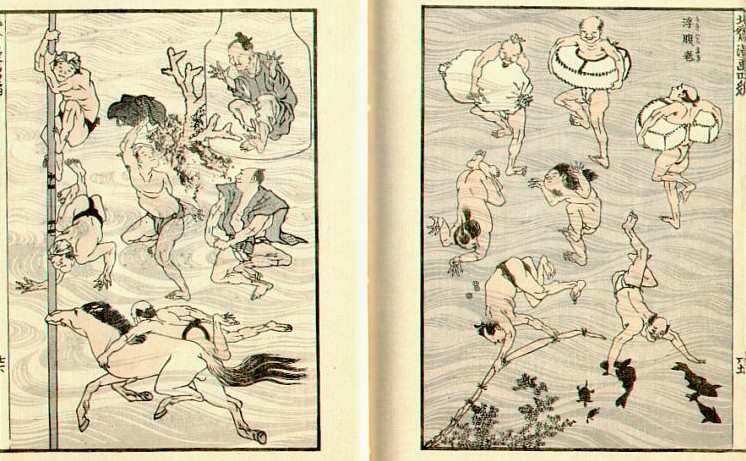
The origins of Japanese illustrative art began to take shape from the 1780's, spreading through Europe in the late 19th Century to rise to prominence and further the field of animation and illustrative art. The images are often violent, depicting Japanese actors, heroes and sports and filled with movement, this began with a series of many small drawings and later influencing more colour prints.

"Hokusai Manga" or "Sketches by Hokusai"
Toulouse-Lautrec - The Influence of Print

From such Japanese works as the illustrative art, Hokusai's Manga and woodblock prints, Toulouse-Lautrec developed a technique that encompassed these idea for a series of inspired European prints. These were often made for events such as theatres and bars, places Lautrec was in collaboration with. These put an emphasis on the stylized prints of line and block colours for a simple and bold print, using mainly primary and secondary colours to promote the Moulin Rouge and other establishments. One such example is The Moulin Rouge Poster which involves a different take on his own work and the introduction of typography is this print-based-media, this developed the way in which we began to communicate through art and advertise before Art Nouveau.
Moulin Rouge Posters by Toulouse-Lautrec.

In conclusion to the Japonisme period, it is becoming to become clear that with globalization and the opening up of borders and trading between the Western world and other cultures, we see a dilution of European culture, particularly in regards to the arts. It proves that many of the techniques we still use in the 21st Century are derivative from the inventions of continents across the world, from the Middle East to Asia, we are constantly influence by new themes of art and design. This is a period in which design became to be influential on furniture and product design. The influence of the woodblock print, silks and decorative motifs resonated the most with European artists such as Vincent Van Gogh and Claude Monet.