Art Nouveau began an international style spreading across Europe, mostly based in the media of architecture and print-based media. The themes and characteristics of this period of design concluded the Japonisme era with design involving curvilinear, flowing forms based on the natural environment. The Japonisme concept of the decorative motif had a long lasting motif that outlasted the art movement and was what Art Nouveau was shaped around. Other influences include the abstraction of imagery and the interplay of spacious background and intricate foreground designs.

Aubrey Beardsley

An artist that worked mostly in black ink, Beardsley was heavily inspired by Japonisme and it's woodblock prints. A British artist, his works could be seen as the height of the Dionysian concepts of sexuality and grotesque mythological forms. However, his work was highly influential on the ideas of fashion illustration, cementing design as an up and coming industry. A specific work of design where this is evidenced is The Peacock Skirt using graphite and ink in 1893.

The Peacock Skirt - Aubrey Beardsley
"The Peacock Skirt" by Aubrey Beardsley, 1893, Graphite and Ink.
Architecture

Architecture became a key focus of European design during the Art Nouveau period. Antonio Gaudi, Victor Horta and Hector Guimard were the vital architects to the designs that still decorate the buildings, streets and infrastructure of Spain and France today, focusing on the organic and natural forms and bringing this into the design based environment. 
Staircase at the House of Victor Horta, Belgium.
Aspects of both Art Nouveau and it's inspiration from Japonisme can be found in the interior designs of Victor Horta. The staircase itself is curvilinear in it's rounded steps and swirling bannister. The flowing shapes of the black metal frame of the bannister and the natural, stem like, flowing form applied and painted to the wall makes it appear that the staircase is almost growing rather than constructed.

Antonio Gaudi's "Casa Battlo" in Barcelona, Spain.
An architect who worked to maintain this alignment with nature, Antonio Gaudi, created what some criticized as unattractive buildings such as the Casa Battlo. The aesthetic form of the building is complete with curvilinear window panes compared with it's surroundings with flowing shapes rather than the modern and traditional theme of rigid architecture. This shows how the process of architecture and construction has developed throughout art history. The roof is arched and curved with an exterior that features mosaic tiling.

The Paris Metro Architecture by Hector Guimard.
The Paris Metro architecture is an in keeping series of architectural infrastructure throughout Paris forming the underground train systems, spanning 303 stations and 387 station halls. The Metropolitain is one of the most well known designs by Hector Guimard made by glass roofs and cast iron.
Art Nouveau was ultimately a movement based on design rather than art, furthering the aesthetic of architecture, interior design, graphics and product design with it's very versatile, organic sense of design. Despite being a short art period of around 35 years, the art has taken permanent route in European architecture, particularly in Paris and Barcelona. 

Post-Impressionism had a complicated relationship with it's predecessor art movement of Impressionism, both celebrating the continuation of it's style after the prominence of Japonisme and Art Nouveau and in a sense also rejecting it's very trivial themes. Key artists of the Post-Impressionist era include Vincent Van Gogh, Paul Cezanne, Paul Gauguin,Toulouse Lautrec and the Pointilism artists Georges Seurat and Paul Signac and the invention of Chevreul's Colour Wheel in 1839.


The major characteristics of Post-Impressionist era art saw a return to painting rather than elements of the design industry. The elements of Impressionism that saw continuation through it's conclusive era included it's technical features such as the thick and sporadic application of paint, the use of vivid colours but with less emphasis on the light and tonal qualities and more on the use of arbitrary colours, moving towards more abstract forms, it attempted to steer away from soft realism towards fragmentation and geometrics.

However, the rejected qualities of Impressionism that were overturned by Post-Impressionism were the trivial subject matters which were swapped with more meaningful and conceptual ideas, as Post-Impressionism splintered or fractured into a number of different subjects as there was little consolidated agreement between the artists on the direction they would go, a reason for this was the spread of these artists in terms of geographical location, therefore, despite exhibiting together, they did not often work alongside one another.

Pointillism

On it's most basic level, pointilism is the brush stroke technique of creating dots on the canvas in such close proximity they create an impressionist style blending of tones to achieve a Post-Impressionist work of art, relying on the eye to do the most of the work in 'connecting the dots'. This technique is carried out in hopes that the optical mix of colours will induce the idea of a spectrum of mixed colours to the brain. Despite being a process commonly imitated again in the 21st Century as a classic skill, it was only practice of a couple of artists at the time, Georges Seurat and Paul Signac.

"A Sunday Afternoon on the Island of La Grande Jatte" by Georges Seurat,
painted in 1886 using pointillism.
In the painting above, A Sunday Afternoon on the Island of La Grande Jatte by Seurat, the image is unknowingly made up of a series of very fine dot marks made by a paintbrush. Only on closer inspection can it be noticed how these brush marks are made. This makes for a very soft and natural mixing of colours in the eye. particularly noticeable in the colours of nature, the grass, the trees and the water.

Paul Gauguin

A stockbroker turned artist, Gauguin allowed Post-Impressionist art become his entire life. After the breakdown of his family he began to paint full time, starting to travel to distant regions to paint. The Painter's Family in the Garden at Rue Carcel painted in 1881 is a bitter sweet image of the family of Gauguin from his early art style. His study under the impressionist painter Camille Pissarro is evident here, years before he moved onto more abstract forms and an early sense of primitivism.

"The Painter's Family in the Garden at Rue Carcel" by Paul Gauguin (1881).
The change in his works were defined by periods in his life at which he changed his lifestyle, his environment etc. For example, his work when living with Van Gogh changed dramatically from an Impressionist style to one that accentuates bold, vivid colours and a more abstract, avant-garde style as his style developed. By the time he living an entirely different life in Tahiti, his work had changed once again, featuring extreme cultural influences and changes in the colours and hues he worked with, painting Tahiti as if it was an entirely different world. As once stated, "In order to do something new, we must go back to the source, to human in it's infancy."
"Nevermore" by Paul Gauguin, painted in Tahiti, 1897.
The image above, Nevermore is a case study of how Gauguin's work steered towards abstraction and primitivism as it endured, as one of the artist who changed technique more than anybody else, he claimed "I shut my eyes in order to see". His use of colours became more dark and twisted with only a slight light, expressing more emotion and culture than his early work, this is the idea behind Post-Impressionism, the development of style and subject matter beyond the parameters of Impressionism.

Other Key Artists

Many of the most influential artists up to now are still considered to be from the period of Post-Impressionism, e.g. Paul Cezanne, a contributor to the ideas that became Cubism, looking at the cone and cylinder type shapes in a composition. Painters such as Vincent Van Gogh and his painting, "The Potato Eaters" from 1885 shows how the subject matter of Post Impressionist artwork had shifted from the trivial to more realist concerns.

Ultimately, Post Impressionist art was a suffix to the Impressionist era, after the rise and fall of Japonisme and Art Nouveau, Post Impressionism began to take shape as artists moved on from the more classic styles and embraced abstraction, moving to the conceptual. An art movement that branches off into a large number of geographical locations, with the directions of artists of the movement being very erratic and not moving in conjunction to one another. Artists such as Paul Gauguin, Van Gogh, Toulouse-Lautrec and Paul Cezanne are artists accredited for their efforts in the art movement.


The symbolist manifesto of 1886 stated that the aim of art should be to "clothe the idea in sensuous form" according to it's publisher Jean Moreas, and illustrates "the ambiguous world of the indeterminate", in the words of artist Odilon Redon. In Europe and in relation to Britain, Aestheticism and Symbolism ran on parallel timelines. Giving a visual representation to the mystical and the occult, artists of the Symbolist era include Franz Von Stuck, James Ensor, Edvard Munch and Gustav Klimt. This art period not only looked back into history but predicted the shifts in art such as Surrealism.

Gustave Moreau

Working in the art movements of symbolism and modern art, Gustave was interested in celebrating Renaissance or return to the previous civilizations, mysticism and biblical imagery. In the year 1891, Moreau began to teach at the Parisian Ecole des Beaux Arts in France, where he taught many of the skills artists such as Henri Matisse to go ahead and master Fauvism and Abstract Expressionism in the future of art history.

Jupiter and Semele - Gustave Moreau
"Jupiter and Semele" by Gustave Moreau, 1896.
The image above, Jupiter and Semele, a mythological painting emphasises some of the qualities of the subject matters of symbolist paintings as they see a return to the themes of Ancient and Renaissance art history. As a singular painting, it is high in ornamentation with a jewel like quality to the paint.

Odilon Redon

Primarily a graphic designer and painter, Redon's artworks adopted a surrealist tone before the artists of the Surrealist art movement had developed. The artist did not want his art to be defined, but to be used to inspire, his work filled with abstract ideas and strange dichotomies, his work was personal on the level that he was documenting the thoughts in his own mind.

"Guardian Spirit of the Waters" by Odilon Redon, 1878 Lithograph.
Guardian Spirit of the Waters is an image that preludes Surrealist art using graphic design. This image uses charcoal and black chalk on woven cream and gold paper.

Gustav Klimt

An Austrian artist, Gustav Klimt created even more abstract images, broken down into the colours and patterns rather than the objects, using fine patterns and shapes to make a whole abstract concept rather than depict a composition objectively. 
"The Kiss" by Gustav Klimt, painted in 1907 - 1908, using Oil on Canvas.
The Kiss uses fragmentation to abstraction in order to symbolise the emotion of the painting, with warm colours and patterning. A complex mixture of ideas, Klimt's work, despite being Avant-Garde, appeared to work in the kitsch ideas before they were founded. However, his works still often have that emotional undertone that resonates with the previous ideas of Romanticism. 

The Scream by Edvard Munch

The Scream (or the cry) by Norwegian painter Edvard Munch, painted in 1893 was by an artist who constantly trying to create angst and portray it in the symbolic way his own mind visualized it's pain. This was a style that ultimately brought about the German style of Abstract Expressionism a few years later. The series of paintings this image is from is set to depict the sadness and melancholy that some experience in their life. The Scream in particular depicts his own experience on a bridge with some friends. He describes the scene as "the sky turning blood red" as the sun disappeared into the sunset, as he "watched from the flaming fjord". This is thought to depict a panic or anxiety attack of some sorts and truly symbolises the feelings of Munch in that moment, recorded using wax crayon and tempera on paper.

The Scream.jpg
"The Scream (or the cry)" by Edvard Munch, made in 1893.
So, in conclusion, the ideas of symbolism were very personal and artist-specific, with very little cohesive ongoing theme, with very individual ideas spanning from the artists dreams and anxieties to the mythological and biblical to the political artists such as James Ensor, every work symbolises something very important to it;s creator, giving the audience an insight into the world of the artist in a Romanticist, emotional way.


'Les Fauves', translated from French to mean "The Wild Beasts" was the title given to the turn of the 20th Century movement of artists that celebrated the beginnings of the avant-garde in France. Known for their painterly qualities; a spontaneous use of colour and brush stroke, artists such as Henri Matisse (1869-1954) and Andre Derain (1880-1954) became widely known for emphasising these techniques with a new and adventurous painting style.

The term "Les Fauves" was introduced after the Summer of 1905, in which Henri Matisse and Andre Derain has worked on paintings with unnatural tones and quick, spontaneous strokes of the brush in Collioure on the Meditteranean coastline, a place later made famous as the inspiration for the Fauves after exhibition at the Salon d'Automne in Paris. Despite being a relatively short lived art movement of the modern era with a very loose base of artists, it was one which was extremely influential on the avant-garde of the future.

The inspiration for the Fauves lies in many avenues of modern art; for example, impressionisms use of deep and vibrant colours contributed to the Fauves use of deep purples, reds and browns to create paintings saturated by colour as well as the Impressionist influence on representational values within these themes. Furthermore, elements were drawn from a number of styles including the rich use of colour and brush stroke shown by Vincent Van-Gogh, Cezanne and the Pointillist works of George Seurat as indicated in Maurice de Vlaminck's (1876-1958) painting Tugboat at the Chatou (1906) which creates it's landscapes by using choppy, broken and fragmented brushstrokes with Oil on Canvas.

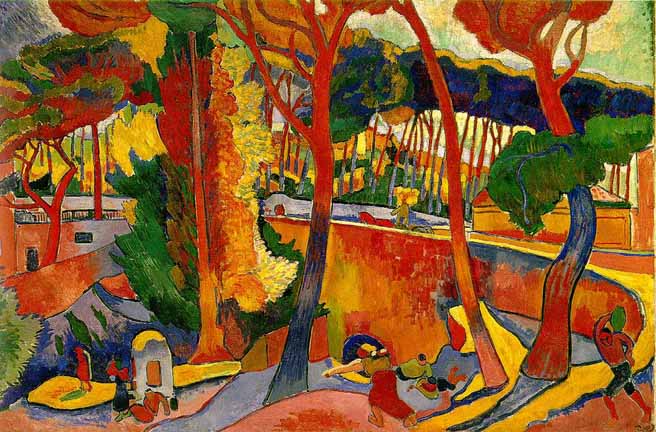
"The Turning Road" by Andre Derain, L'Estaque, 1906.
The Turning Road, painted by Andre Derain in 1906 is a demonstration of the root characteristics of what Fauvism meant. The colours used are arguably the most striking concept within the painting - almost appearing to maintain a sense of primitivism with it's adherence of the avant-garde. Also, the type of brush stroke is evident an it's application of these colours, creating a texture by using scratch-like, fast and repetitive smatterings of deep coloured paints.

Paul Gauguin once described the fundamental theme of Fauvism to Paul Serusier in 1888, before the introduction of the movement itself, stating "How do you see these trees? They are yellow. So, put in yellow; this shadow, rather blue, paint it with pure ultramarine; these red leaves? Put in Vermillion." This shows an initial and outright attention to the prior mentioned representational value and the emphasis we put on the way we see light and colour - a very impressionist response to painting a landscape. However, the variances in these representations can be noted through a number of differently styled impressions of similar compositions in the same places such as the Gulf of St Tropez.

"Portrait of Madame Matisse. The Green Line"  painted using Oil on Canvas by Henri Matisse, 1905.
The image above, "Portrait of Madame Matisse. The Green Line" by Henri Matisse, depicting a portrait of his own wife, Amelie Noellie Matisse-Parayre is yet another similar example of how a use of deep colours is instrumental to a unique take on the representative values when painting from observation - with the Impressionist use of light and shadow, looking towards abstraction.

There is, however, a very personal connotation to the way these scenes are painted as identified by many artists ideas of their own works, for instance, during the Fauve Summer in Collioure in 1905, Matisse once wrote, "Working before a soul-stirring landscape, all I thought of was making my colours sing, without paying any heed to rules and regulation." This gives us a true insight into what Fauvism meant to these artists and why they would be described as "wild beasts", it was because their painting paid no mind to rules and allowed them to be free in their representation of any given theme, a new and unruly perspective on the French Summer.

"Victoria Embankment" in London, as painted by Andre Derain 1906-1907 at 81cm x 100cm using Oil in Canvas.
After a trip to London in the years of 1905 and 1906, Andre Derain produced a high quantity of sketches of iconic scenery in the city, specifically the image above of the The Victoria Embankment, he would then take these sketches back to his studio in Paris to be painted with the classic Fauvist ideals of colour and texture. While different colours; blue, yellow, brown and green dominate the image, this style has already become synonymous with various other works of Fauvist artists.

This seasonal and short lived art movement ended periodically alongside the ending of the Fauve Summer in Collioure as the artists once again parted ways on the 24th August 1905 with a large quantity of over 70 paintings and almost 200 drawings combined, but would return for several subsequent years in the future.


Originating in Germany, Expressionism is a vital component of modern art. It focuses on the subjective matter rather than the objective, with heavy emphasis on emotion and personal perspective. Mostly known for the art it produced during the early 20th Century, it also provided music, film, architecture and literature that conformed to a similar, subjective subject matter. Such ideas were considered to be adverse to the highly esteemed German academic art of the period - inspiring splinter groups such as Die Brucke and Der Blaue Reiter.

Before the turnabout of the First World War, Expressionism was the product of the German avant-garde contribution to European art. Known for it's twisted abstraction of reality in order to promote an idea or emotion - looking at the context rather than the physical qualities portrayed prior to this art movement. Much of the influence for Expressionism came from the customs of the Symbolism art movement and the often shocking demonstration of emotion in art shown by Vincent Van Gogh and Edvard Munch, famous for The Scream, one of the most famously terror filled paintings that depicted the artists personal thoughts and feelings at a traumatic time. However, it's not to be forgotten the influence that African art had on the nature of the painting's aesthetic and primitive qualities.

In 1905, a group of artists from Dresden, in Pre-War Germany formed the Expressionist group Die Brucke consisting of artists Fritz Bleyl (1880-1966), Erich Heckel (1883-1970), Karl Schmidt-Rottluff (1884-1976), Ernst Ludwig Kirchner (1880-1938) and later artists such as Emil Nolde in 1910. These artists were dissatisfied by previous themes and subject matters portrayed by art movements and looked into surrounding themselves with a working class neighbourhood. They operated with a collective style of vivid colours, similar themes and scenes of angst and tension before disbanding in 1913, a year before World War I.

Der Blaue Reiter, or, The Blue Riders were another group of artists running parallel to Die Brucke from the year of 1911 in Munich, Germany. Formed from artists Franz Marc, August Macke, Wassilly Kandinsky and others, this group was less tightly based with varying approaches and ideas, but looked to explore the 'spiritual truth' throughout their paintings. The techniques Der Blaue Reiter stood for, however, were linked - the connection between art and music, the importance of spontaneity and spirit along with a meaningful use of shape and colour with a symbolic context. Much in line with modern art ideas, they had a focus that likened them to primitivism which led to the cubist movement, often portrayed through simple street scenes and figurative art. The collective eventually disbanded after three years in 1914, when some artists migrated such as Kandinsky moving back to Russia and others were later conscripted and later died in combat including Franz Marc and August Macke. However, the influence of Der Blaue Reiter had more resonance and influence than it's counterpart, finding it's place in the future of the Bauhaus in the 1920's thanks to Kandinsky and Feininger.

Wassily Kandinsky (1866-1944) was a Russian born artist that closely encapsulated the ideas of expressionism, providing years of work that contributed to the art movement. His works from the early 20th Century are directly relative to the idea that art and music are intertwined, that sound and rhythm can be portrayed through painting - better known as synesthesia. He was known for his attachment of colour to particular feelings and sounds. Once explaining, "Colour is a means of exerting direct influence on the soul." With influences such as Vincent Van Gogh and Henri Matisse due to their own use of colours.
"Composition VII" by Wasilly Kandinsky (1866-1944), painted in 1913 using Oil on Canvas, 300 cm x 200 cm
The image above, Composition VII is an example of how Kandinsky would channel his understanding of the relationship between colour and sound and feeling into an artwork of abstract shapes and tones to an almost unintelligible degree. He described his concept as, "Red may cause a sensation analogous to that cased by the flame, because red is the colour of the flame. A warm red will prove exciting, another shade of red will cause pain and disgust through association with running blood...colour awakens a corresponding physical reaction." This relays the importance of every shade and tone, the title of "Composition" indicates it's close link the Kandinsky's visualization of music.

Ernst Ludwig Kirchner (1880-1938) was a well known painter and printmaker in Germany from the Expressionist period as part of the Die Brucke movement, his work can be noted as featuring these working class areas that similar artists immersed themselves in. His artworks often taking on the slight abstraction of Expressionist themes such as figurative painting and street scenes, documented in his "Berlin Street Scenes". His works are highly influential to modern art despite his paintings being considered as "degenerate art" by Nazi Germany in 1933, leading to 600 of his works being destroyed before his eventual suicide in 1937.

"Berlin Street Scene" by Ernst Ludwig Kirchner, painted from 1913 - 1916 using Oil on Canvas.

These Berlin Street Scenes give us an insight into the daily life of people in Germany before the outbreak of World War One. Kirchner uses deep colours and abstraction of these figures for a distortion and emotional effect on the audience. With sharp lines and a curvilinear perspective, our view of Berlin at this time has been distorted, something Kirchner wished to achieve.

Entartete Kunst or Degenerate Art is the name given to the art that was rejected and destroyed by Nazi Germany in the 1930's. This process saw the banning of previously well known German Expressionist artists in favour of more Neo-Classical styles. Die Brucke and Der Blaue Reiter artists were all inclusive in this ban. While Germany was limiting the art scene, Modern art was seen as a symbol of freedom, where many of these artists were accepted as refugees to the United States.

Furthermore, in 1937, The Nazi government held an exhibition of this so-called Degenerate Art with 600 of Kirchner's works being destroyed along with 700 of Erich Heckel's own. This was replaced by art that was supported and endorsed by the Nazi Party to the Germanic people with an ingrained Apollonian theme that developed into World War II propaganda style.

"Water Sports" by Albert Janesch, painted in 1936 using Oil on Canvas. 
The style of painting above shows a reactionary, but ultimately rare regression in Modern Art. No longer were artists attempting at this point to achieve abstraction, to provoke controversial and thought provoking meanings to expose the truth to the audience. This was art with purpose and agenda. As a form of Nazi propaganda, it can demonstrate a history lesson. Germanic people were considered to be Apollonian and idealistic with Aryan features, light complexions, strong physique and hard workers, a turnabout from the art of the Expressionist progressives.

 Conclusively, the art of the Expressionist era came to a very abrupt end - with very little volume of surviving works. While many of the artworks remain simply as photographs as a result of Nazi Germany's destruction. The contribution of many of the artists from groups of Expressionists such as Die Brucke and Der Blaue Reiter have had a profound influence on the shaping of 20th Century modern art and the way in which we visualise modern painting concepts.


Cubism was the period pioneered by artists such as Pablo Picasso and Georges Braque between 1907 and 1914 as inspired by the earlier work of Paul Cezanne. Based in France and Northern Spain, L'Estaque and Horta de Ebro, respectively these artists were responsible for the development of abstracted shapes and primitivism with a focus on multiple points of perspective and shape.

Paul Cezanne (1839-1906) was a French Post-Impressionist painter dedicated to a new theory of art as the world moved into the 20th Century. As a major inspiration for the cubist movement, one of his many ideas was to "treat nature in terms of the cylinder, the sphere, the cone. Everything in proper perspective so each side or plane of an object is directed towards a central point." This meant that Cezanne was attempting to further the dimensional elements of painting and break beyond the planar perspective, this would be something that artists such as Pablo Picasso would aim to evolve in the years following Cezanne's death, gearing himself towards the idea of pure abstraction.

There were many established style of cubism developed over the seven year period; Facet cubism portrayed the viewed image as broken up facets across the image, all of which representing a differently angled viewpoint on the object, this causes changes in shape and faceted use of colour. Images that conform to this theme of Facet Cubism include Georges Braque's (1882-1963) paintings of L'Estaque in 1908, looking at factories, houses and viaducts at various angles in order to achieve an image not seen naturally by the naked eye. The same concept can be applied to Pablo Picasso's use of Facet Cubism in his paintings of Horta de Ebro in 1909, using sharp, geometric angles to depict the ever changing viewpoint.

"Factory at Horta de Ebro" painted by Pablo Picasso in 1909.
The above image is an important example of how a changing viewpoint can effect the dimensions of an object, the multiplicity of such has furthered the sense of abstraction that Picasso is trying to achieve with cubism. As with many cubist paintings by Picasso and Braque, a very strict colour scheme is used, often consisting of natural and harmonious colours. In this case, orange, grey and green are used in contrast to fragment and facet each dissected image of what Picasso visualises at Horta de Ebro.

Analytic Cubism differs from Facet Cubism as it first dissects the image, before rearranging the parts. rejecting classical techniques of painting in regards to light and perspective. These paintings would change reality rather than skew it, creating an almost new object as they were not bound or confined by colour, tone, texture or shape to portray a particular image. The idea of the motif is important as these images are a product of a redesigned composition of sides and planes. As not seen in facet cubism, this concept allows for further abstraction as seen via intersecting shapes, impossible angles and incoherent composure of line. However, the colours within Analytic Cubism tend to depict neutral and harmonious tones.

"Still Life with Violin & Pitcher" painted by Georges Braque, 1910.
Analytical Cubism can be found in Georges Braque's painting "Still Life with Violin & Pitcher" this is most evident in the way the artist has used colour - or a lack of it. The neutral tones, consisting of browns and greys allows for the composition to garner the most attention for it's sharp and rearranged nature. This is where it differs so much from facet cubism; while faceted, the image is still mostly coherent, while in analytical cubism, the image is so disoriented and broken down to it's basic form of simply lines, geometry and shape that the underlying sense of perspective is almost lost in Braque's signature stylization.

Hermetic Cubism was ultimately created as an opposing reaction to the style of analytical cubism. This phase of the art movement was founded on the idea of planes acting as if panes of glass. In other words, sections of the composition will be placed in parallel with the edges of the format so as to conform with the basic shape of the object while also synthesising the reality of the object with the flat nature of the canvas on which it lays, as if reassembled from the composure of analytical cubism. 

"Still Life with a Guitar" painted by Georges Braque, 1914.
"Still Life with a Guitar" is a painting which Georges Braque uses to experiment with the ideas of Hermetic Cubism. It focuses more on the plane of perspective and connected compositions than of singular elements. The planes of the image itself uses block colours to separate each "pane of glass", serving to disconnect the aspects of the object in clusters, disassembling the image in parts. This also saw the inclusion of typography and the use of a collage style previously unused, which became popular thanks to the Cubist movement. This would only be further developed in the later years of the period. 

Synthetic Cubism, the final phase of Cubist style, was perhaps the most significant development to the seven years, created in the later period between 1912 and 1919. With the collaboration of further artists such as Juan Gris (1887-1927) and others. This developed cubism beyond the simple abstracted paintings and towards mixed media; a combinations of more planar use of colours, the collecting and grouping of objects rather than dispersal and the utilization of decorative patterns initiated by hermetic cubism. The use of text and newspaper cuttings at this point became common. Much of which had an underlying critique of the ongoing war in the Balkans and the First World War later that decade. 

Picasso; Glass and Bottle of Suze; November, 1912; Pasted papers, charcoal and goauche; Washington University Gallery of Art, St. Louis
"Bottle of Suze, November 1912" by Georges Braque, made with Newspaper, and Wallpaper.
Georges Braque's use of collage techniques in " Bottle of Suze, November 1912" was an innovative beginning to a style that is ongoing in modern art and crafts. Using clippings from newspapers he creates a contemporary work of art that related to the Balkans War, while still maintaining the new decorative developments of the cubist style. Once again, tones are limited to being neutral and harmonious, so while this is a fresh style. It is still reminiscent of the original ideas of the pioneers of Cubism in 1907. 

Juan Gris (1887-1927) was an artist that pushed the ideas of Cubism to the edge of their own meaning. He revitalized the techniques later on with bold colours, almost with a sense of luminosity. With a much more refined and personal technique, he was more abstract in his use of collage with more ornate decoration.

Still Life before an Open Window (Place Ravignan) - Juan Gris
"Still Life Before an Open Window" by Juan Gris, 1915 (Synthetic Cubism).
In conclusion, the core elements of cubism have paved a foundation for future modern artists to not only be influenced by, but to adopt the style in a variety of formats. An example of such an artist is David Hockney, his 'joiners' collection of photograph are a reminder of the cubist use of multiple planes and perspectives in one image. Furthermore, many artists have also derived parts of their work from artists from this movement and name Pablo Picasso a significant influence.
 
Operating around the Manifesto of Futurism (1909) as written by the Italian poet Filippo Tommaso Marinetti which set forth the underlying principles - a rejection of history, a passion for speed, movement and dynamism, a love for the industry and machinery of the technological age. The Futurists are known for their rejection of art critics and the Apollonian terms of "good taste" and "harmony". Key artists of this period include Giacomo Balla (1871-1958), Umberto Boccioni (1882-1916) and Tullio Crali (1910-2000).

Among other disciplines, typography and graphic design started to gain prominence in Italy at this time, FT Marinetti's graphic typography was inventive, abandoning classic structure, grammar and punctuation in favour of aesthetic detailing, an example being his sound poem book "Zang Tumb Tumb" which develops the shaping and geometry of font design, the distortion and abstraction of text.

"Depero The Futurist" by Fortunato Depero (1913-1927) Book bound by two bolts.
Fortunato Depero's "Depero The Futurist" emphasises the importance of bold, structure like typography to Futurists. It also shows how influential Futurism has been on the fonts used in the 21st Century.

The Futurist Manifesto did not only dictate the style of the movement, but the ideals that it's contributing artists' supported - a fascist idealogy. It also celebrates a a rejection of previously upheld values. For instance, Umberto Boccion wrote "We rebel against that spineless worshipping of old canvases, old statues and old bric-a-brac, against everything that is filthy and worm-ridden and corroded by time." before going on to claim, "We consider the habitual contempt for everything which is young, new and burning with life to be unjust and even criminal." Ultimately, this meant that Futurism was a true rejection of past ideas; the classic thoughts on taste and aesthetics, the reverence that upheld traditional painting and the society which made this a popular standard.

Umberto Boccioni's "Elasticity" (1912) Oil on Canvas, 38 by 39 inches.

Italian painter, Umberto Boccioni (1882-1916) was a pioneer of this movement; wishing for his work to extend beyond the canvas in terms of it's representation of energy and movement. Elasticity is an artwork that uses his developed techniques to display this energy through a horse and it's rider, fragmented almost to the point of abstraction - we understand little about the image but it's sharp angles and shapes. With deep colours, the image exhibits a new age of energy and movement serving to make the horse-rider appear to be mechanized. This is a common trait of Boccioni's paintings, a familiar characteristic, as the artist claims "the figure must be broken up and enclosed in environment."

Giacomo Balla (1871-1958) is another artist that depicts the mechanical age in his art as well as an idealistic view of this era in Italian and European history. In the painting below, Speed of a Motorcycle he abstracts the movement of bicycle wheel spokes where the repetition of the wheel's rotation is the primary focus - with spirals and curves depicting once again a mechanical motion. This is furthered by the use of sepia tones in contrast with Boccioni's use of deep tones, while Balla opts to use colours that resonate with the theme of industry. For this reason, Balla's work is indicative of the ongoing themes of Futurism as an art movement.

"Speed of a Motorcycle" by Giacomo Balla (Italian 1871 - 1958), 1913.
Futurism is always playing with perspective and fragmentation of an image for a sense of abstraction that lies with this idea of motion and dynamism that they want to celebrate, to the extent at which this pandered to the propaganda of the time - the focus on manufacturing and furthering of technology. This is implied in Fedele Azari's Perspectives in Flight (1926). This image paints the Italian skyline in a way that we are not familiar with, with a utopian-like quality - a tilted perspective and abstract colours, representing their new world the 1920's being a time of innovation.

"Perspective in Flight" by Fedele Azari, 1926, using Oil on Canvas at 120 by 80 cm.

Tamara de Lempicka (1898-1980) was a Polish-American artist that worked in a slightly different manner to her contemporaries, applying some of the Futurist styles and techniques to her own skills in portraiture. For instance Self Portrait (1925) is a painting that is focused on the artist herself, but still maintains elements of sharp angles, deep colours and the illusion of movement. However, Tullio Crali (1910-2000) takes a different approach at depicting the mechanisation of Italy, as if from the perspective of the pilot of an aircraft, the title is Nosedive over the City which was painted in conjuction with the Futurist fascination with transport, but taking shape towards the end of the movement in 1939.

Tullio Crali's "Nosedive Over The City" 1939, Oil on Plywood, 120 by 140 cm.

Conclusively, Futurism was the art movement that depicted the hope for a new age in Italy before Europe's descent into World War II. But before it's end, Futurism had become a symbol of propaganda, the artists involved were seen to be glorifying the prospect of war with targeted imagery. This was only fuelled by the prominence of the relationship between Italy and Germany and their leaders, Mussolini and Adolf Hitler, respectively. Marinetti wrote in the Manifesto of 1910, "We will glorify war - the world's only hygiene - militarism, patriotism, the destructive gesture of freedom-bringers." This hinted towards a future allegiance that aligned the Futurist artist on the side of this new ideal - Fascism. This would eventually become the downfall for artists such as Umberto Boccioni, Giacomo Balla and Tullio Crali as the art movement drew to a close.