Prehistoric Art refers to the period at which art pre dates our basic understanding of history and civilization, beyond any knowledge of art. Attributed to the ideas of preliterate and basic cultures; primarily Homo Sapiens, Neanderthals and Early Hominids making use of primitive tools and materials, this period challenges the point at which we begin to describe these forms and marks as 'art'. Many of these artefacts are found in the modern world by archaeologists. Examples of these early artefacts are thought to be dating back to 30,000 BCE, such as Venus of Willendorf, believed to be the earliest ideals for the female form fromt the Stone Age, up to the Makaspansgat Pebble, South Africa, thought to resemble the human face up to 3,000,000 BCE. Despite these findings, most Prehistoric art is found in Eurasia.

Venus of Willendorf, Austria, 30,000 BCE
Makaspansgat Pebble, South Africa, 3,000,000 BCE


Prehistoric artefacts also serve as our gateway to finding out about these little understood hunter-gatherer societies, therefore having an importance to both science and history. Due to Prehistoric art, we have learnt more about the skills and brain capabilities of early humanoids. 

Cave Paintings

Some of the most common examples known of Prehistoric art are found in the caves of Western Europe, examples being the Chauvet Caves of Vallon-Pont d'Arch, France (30,000-28,000 BCE), showing the earliest known figurative paintings in the world or the Lascaux Cave Paintings in Dordogne, France (15,000 BCE) both of which were the markings of pigment on the stone walls. These caves have survived abandonment and rediscovery in 1879, at first understood to be fakes, they eventually redefined our beliefs about the early people of the Stone Age.


Lascaux Cave Paintings, France, 15,000 BCE

Styles of these cave paintings tell much about the lifestyle of hunting animals e.g. hyenas, horses and bison with extraordinary detail, using pigments found in clays such as red ochre, other clays and charcoals.

Prehistoric Art in Britain

In a British context, Stonehenge is the most relative example of Prehistoric Art. In Wiltshire, Stonehenge is considered one of the Seven Wonders of the World, comprising of a ring of standing stones built up to 3000 BCE. The area of Wiltshire is of great significance to archaeologists where further extensions of the standing stones can be found, most recently the existence of a Superhenge five metres below the ground level. This is an example of how dating technologies help us reveal the histories of these artefacts.

Stonehenge, Wiltshire, England, 3000 BCE.

Where does Prehistoric Art end and Ancient Art begin? the answer is found in the idea that humans at this point had developed a more innate understanding of settlements and early civilizations which emerged parallel into the Near Eastern, Egyptian, Roman and Greek civilizations that we have a more in depth knowledge of in the present day, which is where the limitations of the Prehistoric world end and art becomes slightly more complex.
Ancient Near Eastern art encompasses the area of Mesopotamia, modernly the region of Iraq and Syria. Traditionally, Iraq is thought to be where civilization first took root and expanded from 5000 years before present. With this development came the idea of settlements and livelihoods centred around organized agricultures and a more domestic style of living, and eventually class systems which resembles our way of living today. Along with this came the introduction of cities and centres of cultural significance.

From the beginning, one of the first societies to emerge was Sumer in Iraq, has provided us with evidence of this in the form of ceramics, figures and Ancient architecture. In Uruk, where the first written language was reportedly used, lies evidence that with Near Eastern Art, a greater philosophical meaning was embedded into the art, despite still being created with a purpose. An example is White Temple and Ziggurat which was an architectural structure made of mud-brick around 3000 BC which emphasises the connection between art and the Gods, in reference to this site, the Sky God Anu, standing above the city walls.

White Temple & Ziggurat, Uruk, Iraq, made from mud-brick, 3,000 BCE
Architecture & Construction

Built within city walls, the focus of the Near East cities is the Ziggurat, an early stylized and geometric development of the pyramid. Typically constructed with mud-bricks, a Ziggurat is a 4-sloped-sided monumental building raised upon a platform, symbolically, the height represented both a higher connection to the gods as well as a sign of 'political authority'. 

The Ishtar Gate is also an important part of Near Eastern Art, as it was constructed as the eighth gate to the Ancient city of Babylon in 575 BCE. Archaeology has since excavated the gate which is now exhibited in Berlin. This serves as an important example of not only the cities structures in the Middle East at this time, but also exhibits the various colours introduced during this time period as a means of expression in their forms of design such as the blues of lapis lazuli and black and yellow glazed bricks to achieve a jewel like texture. 

Ishtar Gate, Constructed in Babylon, 575 BCE, now exhibited in Berlin, made of cedar structure, lapis lazuli, yellow and black glazed brick.

Sculpture & Definition

By around 3,500 BCE, the Near Eastern civilization had begun to develop their skills in sculpting and definition in the figure, losing the childlike quality which plagued the cave paintings from previous millennia. This can be seen in the Ishtar Gate's definition of the lion patterning, or the improving proportions of statues and figurines. 

Sculpture itself was typically crafted from rock cut-relief or from cast metal, which showed a developed skill in manufacturing and metalwork. Furthermore, there was a diverse spread of the art of sculpting, from figures carved into the sides of architecture, to life-scale sculptures, to small figurines which could be transported during migration. Despite the varying nature of different styles, this added to the idea that this era was not creating 'art for art's sake' but instead meaning it as a form of decoration and ornamentation with a meaning that can relate to worship or class related wealth and power, this can be exhibited in sculptures; Ram in a Thicket, a work from 2,600 BCE found in a tomb in Tell Muqayyar as a sign of wealth crafted from lapis lazuli, copper, red limestone and bitumen, highlighting vibrant tones, as well as the Statuettes of Worshippers, which have been partially lost from Eshnunna, reaching only 30 inches in height. 

Ram in a Thicket, Muqayyar, Iraq, 2,600 BCE.
Statuettes of Worshippers, Eshnunna, Iraq, made from Gypsum, Shell and Black Limestone, 2,700 BCE.
However, many of the artefacts of the Ancient Middle Eastern world have been lost to degradation, war and terrorism, for example the Iraq war in 2003, or ISIS most recently destroying the City of Nimrud has led to the damage or destruction of an ever increasing number of these Ancient cities and have now become ruins.

Ultimately, Near Eastern Art bridged the gap between Prehistoric Art and the beginnings of Ancient Art, developing in parallel to other civilizations such as the Egyptian and later Greek and Roman empires, it is clear that Middle Eastern art has had a profound impact on our perspective of art today and it's impact in terms of architecture and sculpture making. 
Ancient Egyptian art is widely known for it's very lavish style and use of rich materials in order to represent the wealth and hierarchic society from which it originates. The beginning of religious depictions in art took a very different approach when adapted to Egyptian beliefs regarding death and an afterlife. The artefacts surviving to the modern day have shown deep rooted links to one another in their materials, pyramid shapes, hieroglyphics and stylized figures these features are highlighted in the Old, Middle and New Kingdoms.

The Nile, now a source of conflict between Egypt and Ethiopia, was once the centre of the Egyptian civilization, with biblical connotations in regards to Moses in the Old Testament, and is thought to be a point of great importance in major religions.

Ceramics, largely pottery, became an important art form to Ancient Egypt, e.g. in Hu and Naqada. In Naqada, earlier forms of pottery were designed with a smooth red texture, to be embellished with black and white paint. Evidence of this pottery has been found in over 900 of the 1500 early Egyptian tombs, and s thought to be significant to the cultural belief in the afterlife, often found in animal or family graves, it is understood that this was the pottery of the lower class Egyptians. However, more embellishments designed with more rare materials are a sign of the establishment of a political hierarchy.


These Fragments of an Egyptian Tomb Painting perfectly captures the style in which Egyptian Art operated. For example, there is little use of perspective, while there is also a lack of movement as bodies are twisted between profile and forward facing features. There is often a repetition, pattern or rhyme to the ways that people or other images are gathered, incorporating a sense of geometry. Furthermore, the colours are very specifically terracotta, light blue, browns, blacks and white and often display hints of symbols or hieroglyphics.

The Pyramids

The Great Pyramids of Giza are the most well known of the Egyptian style of architectural structures. Built around 3,000 to 2,500 BCE, standing at a height of 450 feet, they remained the tallest structures in the world until the Eiffel Tower in 1889. This ambition in construction was meant for that of a lasting civilization, taking generations to build, the creation of the pyramids became a cultural focal point.

The Pyramids of Giza, Egypt, 3,000 -2,500 BCE, made of Limestone, 450 feet high.


Egyptian Art, mostly, follows on from the themes and purposes of Near Eastern Art in relation to it's emphasis on Ancient styles of architecture and sculpture, as well as it's focus on empire building, religious worship and signs of hierarchy. Aesthetically, two styles can be compared in their attention to geometry in city structures and the introduction of new rich and vibrant colours.
Ancient Greek Art is typically celebrated for it's idealist imitation of perfection to the point of distortion, but focused mostly on the building of a new empire; the majority of early Ancient Greek Art was from Sparta or Athens, and can be attached to the perfect human form in sculpture or the innovative features of architecture and new types of building to house a newly democratic city in Athens. Later on, this would move into the Hellenistic Greek Art period in which the style of art making spread to all of the Greek Islands. Ancient Greek art would later shape and influence Classical Roman Art.

The Origin of Drawing can also be an accolade attributed to the Greeks, with the idea of Dibutades and the first relief sculpture in order to preserve the memory of his daughter's distant boyfriend for her. Despite this being considered an average Greek myth, this has influenced much of Classical Greek art in it's experimentation with the ideal human figure.

During this period, Ancient Greece had developed into an almost modern society in it's application to  mathematics, arts, literature etc. thanks to minds such as Plato, Aristotle and Socrates which have become an influence in today's Western World. The Ancient Greek era of art started only years after the establishment of democracy in Athens.

Greek Architecture

When looking at Greek Architecture, the Three Orders must be understood in their derision from the human form; Doric, Ionic and Corinthian structures which vary in form from masculine styles to the feminine design of the Ionic and Corinthian. Firstly, the Doric column does not rest on a platform, but on the ground below as shown in the Temple of the Delions, Delos. Secondly, the Ionic structure consists of a base which separates the stylobate and the column's shaft, decorated with paired scrolled volutes curling from the column's top. Finally, Corinthian columns are noted for their tapered shaft with very intricate detailing of leaves and scrolls. Classic examples of architecture unique to Ancient Greece include the Temple of Hera (550 BCE), or the Acropolis (c. 500 BCE). The Acropolis is an example of a typical Greek structure with doric columns and a shallow roof or pediment. Despite the Acropolis being slowly degraded, it has maintained a strong basic shape.


The Acropolis, Athens, built around 500 BCE, features doric columns and a shallow roof or pediment.

Greek Sculpture

Greek sculpture and it's illustration of the human form is based on the theme of idealism rather than realism, attempting to replicate the strength and beauty of the Gods. Greek figures were strong and proportioned to the point of distortion to reach a level of perfection considered unnatural. These classic sculptures often incorporated use of the golden ratio to guide figures into the most aesthetically appealing proportions.

An example of the perfection of Greek Sculpture is Myron's Diskobolus (Disk Thrower) from 440 BCE r highlights the athleticism required for Ancient Greek Sculpture, as most male figures were either sportsmen or warriors, this sculpture in particular gives us an insight into the lifestyles and aspirations of the Greek era. This sculpture is made of bronze, standing at a height of 61 inches.
Myron's "Diskobolus" (Disc Thrower) c. 450 BCE


It can be noted in relation to this sculpture, that the figure is of optimum body type, in an Olympians pose to highlight the perfection of it's tone and muscle. It also embodies the perfect proportions as idealized by the Ancient Greeks.

It should also be recognized that most Greek sculpture from this time period has degraded over time, only leaving a colourless tone to the figures, while if seen during their initial conception, they would have been created in vibrant colours despite the common trend of misconception is that these sculptures were intended to be colourless or white. An example of what a restored or original sculpture would have looked like can be seen below as opposed to the modern style devoid of 'polychroming'.

"Peplos Kore" from Acropolis, Athens c. 530 BCE around 48 inches in height.


The early Greek sculpture above indicates that despite popular belief, the art of the Ancient Greeks had the ability to be vibrant and bold, mostly focusing on reds, and primary and secondary colours, i.e.. deep blues and greens. This is important as it shows how the level of preservation of this Ancient type of art is vital to it's modern legacy and how it is perceived today.

Greek Theatre

The beginnings of entertainment were celebrated by the Greeks in a more social manner, with infrastructure dedicated this art form.


Polykleitos the Younger Theatre, built c. 350 BCE in Epidauros, Greece.


The theatre above is a famous and typical example of how an amphitheatre is structured, situated upon a hillside in order to help the audience visually and acoustically in order to overlook the centre stage. However, nowadays, these have become classic evidence of Greek civilization, with infrastructure like this and ancient examples of architecture become essential to the Greek tourism industry.

The Greek Tragedians also had a profound impact on the way that performance art, screenplays and acting all worked with three geniuses which impacted and changed the way theatre worked. Firstly, Aeschylus was responsible for the creations of sequels and trilogy as well as applying a second character to create a more dynamic dialogue over the writing of eight plays. Secondly, Sophocles mastered the adding of a third actor in order to add more drama in a complex scene, this served to strengthen characters through subtle characterization and plot. An example of a Sophocles masterpiece is Oedipus the King. Finally, Euripides was known for his ability to develop a new stance on Greek mythology.

To sum up the art of Ancient Greece, it has left us with it's sculptural forms of idealism and athleticism, but has also created millennia lasting structures of architecture such as the Acropolis and the Temple of Artemis. Much of which artwork is a feature of modern marvel of ancient techniques.

Ancient Roman Art, not including the Byzantine period, lasted almost 1000 years, beginning with the Roman Republic Art from 509 BCE. Art of the Roman Empire can be likened to it's inspiration and recycling from Ancient Greek Art, however, it can be defined as the period which comprised of and relied on architecture and sculpture as a monument to the empire. Evidence of Roman Art is still very relevant as it's durable and strong structures have lasted to the present day.

Materials & Construction

The materials, techniques and construction of the Romans is still considered unique in it's efficiency and dynamics today. As the Roman empire expanded, it came to follow in the footsteps of the Ancient Greek period, first working in clay and terra cotta before moving onto more complex processes and materials such as the lost-wax process to construct bronze sculptures and mixing copper and tin as well as mastering the shaping of metals and marble.


Roman Architecture

 Roman  Architecture is once again based on the structural qualities of Greek architecture, but introduced new features such as arches and domes. This style of building expanded during the Pax Romana, a time of Roman peace time and expansion. The materials were based on concrete for strength and durability in order to stand the test of time, this is sometimes referred to as the Concrete Revolution. A common material also used was the Roman Brick, a fired clay brick produced in a kiln and stamped by the region in which it was produced. An example of use of this brick is the Basilica of Constantine in Germany.

In terms of infrastructure, the Romans devised a more civilized society in terms of settlements, health and hygiene and access to food and water, putting an emphasis on public buildings. This way of building is exemplified in the construction of aqueducts, heating systems, watermills, amphitheatres and more basic construction including notable Roman roads, accredited with the development of the modern road, they were essential to trading goods and transporting public and military, often described as highly durable and innovative in their construction. Aqueducts also aided sewer systems and latrines.

However, bridges, dams and canals are all scattered across the relics of the Roman Imperial Art, decorated with these features along with gardens and monoliths. For this reason, Roman Architecture is one of the most defining subjects of this empire due to it's influential style in what it has inspired in the modern era and it's durability, long withstanding other landscapes and constructs. Examples of noteworthy Roman Architecture include, the Colosseum, the Pantheon and even Hadrian's Wall in Britain.

The Colosseum, c. 70-80AD, Built of stone and concrete in the centre of Rome, Italy.


The Colosseum, as shown above, is probably the most well known example of Roman Architecture and is the destination of tourists from around the world. Built of concrete and stone, it is considered to be the largest amphitheatre in the world and a marvel of engineering to both Ancient and modern experts. Capable of holding an audience of 50,000 to 80,000 people, it was used to entertain with other forms of art such as gladiators, animal hunts, mythological dramas etc.

Roman Fine Art 

In terms of Fine Art, Ancient Rome is not considered to be fluent. As owning more art was seen to be better, it was all about the aestheticism to the owner, with most surviving Roman artworks originating from Pompeii as they were preserved by the destruction caused from the volcanic eruption in 79 BCE. Themes of painting revolve much around the basic landscapes and representations of the empire itself, focusing on presentation. This is emphasised in the Nile in Flood (80 BCE) Palestrina, below.

Nile in Flood, Palestrina: Museo Archeologico Prenestino, (80 BCE) A mosaic produced from model.

 To conclude the Roman Art era, it can be seen that there are several routes of inspiration, adoption and adaptation from Greek styles of art. This is most obvious in sculpture and architecture. However, it is also vital to understand that the Roman empire is responsible for some of the most basic infrastructure and inventions that we have today, providing a basis for which the Ancient style of civilization could end and begin a new era. For this reasoning, we would not be living in the same developed world as we do today if not for the Roman Empire and what emerged from it.                                                 

Byzantine Art was initiated by the continuation of the eroded Roman Empire in the Middle Ages. Predominantly Greek speaking, the empire was founded by Byzantium, the capital of which Empire was Constantinople. Out surviving the fall of the Roman Empire until the take over form the Ottoman Turks in 1453. The art of the Byzantine period was defined primarily by highly religious imagery and themes and showed a major departure from the similarities which likened Ancient Greek and Roman Art. The region of this empire was parted by the Mediterranean Sea and encompassed parts of modern Bulgaria, Macedonia, Spain, Italy, the Middle East and Northern Africa.

Not wavering from it's classical ancestry, the Byzantines considered themselves to be Romans, but this was largely a new aesthetic.

One of the biggest departures from the classical arts of Rome and Greece is the abandonment of the realist or naturalistic approach in favour of a more stylized and symbolic representation of an often religious theme. The format and materials used for Byzantine art were very characterized by it's beginnings with the use of mosaic tiles as decoration for churches and domes.

Emperor Justinian I and his Retinue, c. 547 AD.
Emperor Justinian I and his Retinue (c. 547 AD) created by mosaic is a Byzantine depiction of the religious, political and military leader of the region and his contemporaries, it displays features prominent throughout the Byzantine period of art as it's stylisation is dominated by a flat and planar perspective with distinct intricate patterning with neutral and blue tones. It focuses on a tapestry like narrative of a deeply religious theme.

Another important part of how the art of the Byzantines became widespread and important to the public as it furthered ideas visited by the Near Eastern period at which time religion and worship was vital to humankind. After the birth of Orthodox Christianity, icons, idols and portable products of religious art were used as a tool to increase the worldwide influence of the faith. An example of this is the painting from the Sinai Peninsula in Egypt portraying the Virgin and Child from the Monastery of St Catherine as shown below.

Virgin and Child Panel painting, Byzantine Empire, 6th Century.
 In the Virgin and Child panel painting from the Byzantine Empire in the 6th Century, we can identify the infiltration of the Byzantine Doctrine of Christianity has embedded itself into the early art of Western Civilisation. This is important to understand how with the migration patterns of people shape the spread and influence of art even before modern society began. Themed such as the blue robes and the child on the Virgin's lap have been repeated time and time again in art for Centuries after this point and far reaching beyond the influence of the Empire itself. 

To conclude on the Byzantine Empire and its themes of art, it is essential to understand the religious undertones and meaning behind every icon and painting as it creates a narrative from which the religion of today stems from, particularly the depiction and interest surrounding the Virgin Mary. Byzantine decoration and architecture can even be identified in the modern world despite the 1453 conquest of the region by the future Ottoman era, establishing a new period and style of art making.

Gothic Art from the period of the 12th Century to the end of the 15th Century, was of influential importance to the Early Renaissance in a reactionary fashion. While the Renaissance is thought of as the "rebirth" of the Classical art style and an Apollonian return to the perfection and beauty of it's forms, Gothic Art acted as it's pre-existing Dionysian counterpart as it was considered to be grotesque and barbaric.

It was during this period that Europe began to rise to prominence in a way which established trade routes and build upon Western culture as it was developing pre-Renaissance. 

Gothic Architecture 

Gothic Architecture is possibly the most notable use of design during this period, responsible for the ornate decoration of churches and other religious architecture, as this developed into the Renaissance styles we're familiar with, it became known as "International Gothic". 

During the Medieval period the Gothic style particularly flourished in regards to building and infrastructure such as castles, palaces, cathedrals etc. The influence extended into the eventual construction of the "Doge's Palace" in Venice, the "Palais des Papes" in Avignon and various other cities such as Prague, Barcelona and Navarre.
Notre-Dame de Paris, France, Completed c. 1345.

The Notre-Dame de Paris in France, as pictured above, is an iconic masterpiece of Gothic Architecture. Completed around the year of 1345, the Notre-Dame is a historically noteworthy Catholic cathedral. The building is unique to previous architecture as in it's construction, it is one of the first to involve a flying buttress, a feature of Parisian Gothic architecture. This consists of vertical masonry to withstand lateral pressure and an arch shape between the buttress and the buildings exterior.

Stained Glass 'Transept Rose' interior of the Notre-Dame in Paris.

Interiors were also a focus of Gothic architecture, highlighted in the Notre-Dame by the transept rose, featuring intricate stained glass, gargoyles and religious imagery which all culminates in an effectively grotesque, heavily ornate and dark stylization of architecture in Northern Europe.

Key influences on Gothic Art

Key artists from this period of art history include Giovanni Pisano, an Italian sculptor who worked on the Siena and Pisa Cathedrals, many of the most prominent works by Pisano include Madonna and Child and The Crucifixion, enhancing the idea that much of the sculpture of the time was highly religious. Jacopo Bellini is an example of a typical Gothic painter, responsible for the founding of the Early Renaissance period, his paintings are reminiscent of the flat and stylized linear painting with a lack of perspective as appearing in his painting of Madonna and Child c. 1455.

It is easy to compare the two images below, both by vastly different artists of the period and conducted in two completely different formats, Bellini's in painting and Pisano's in sculpture. The vital comparison is the scene of Madonna and Child that both artists are trying to depict. This emphasises the focus that Gothic art and Early Renaissance art had on the religious themes and decoration for cathedrals etc.

Giovanni Pisano's "Madonna and Child" sculpture
from the baptistry, Pisa Cathedral.

Jacopo Bellini's, "Madonna and Child" painting, c. 1455.


To conclude, Gothic Art was responsible largely for the beginning of the Early Renaissance era and the return to faith based imagery, this was art for the purpose of decoration, mostly in regards to both exterior and interior construction and architecture. Much of the building made during this period can still be seen in regions of Northern Europe such as France, Spain and Italy. 

The Italian Renaissance, from the 14th to 17th Century was the introduction to the Early Renaissance. The word Renaissance is the Italian term for 'Rebirth", this is relevant to the idea that the art and literature of the Renaissance period, which bridged the gap between the Medieval and more modern world, reverted back in order to imitate the styles of Classical Civilizations, namely Roman and Greek art.

In terms of the themes of Renaissance art, it looks back at the archaeological findings particularly of sculpture and painting in order to represent the religious tones, the idealistic forms and the Apollonian ideas held by both the Greek and Roman Empires. The Renaissance can be further broken down into three major periods; the Early Renaissance from 1300 to 1453; the High Renaissance from 1453 to 1527 and Mannerism from 1527 to 1600. With the former being known for the literature of the time and Florence and Siena artists and writers such as Bondone and Dante, the High Renaissance referred to the art and achievements of Raphael, da Vinci and Michelangelo marked by the fall of Constantinople to the Ottomans and the later movement of power from Italy and the Vatican towards Northern Europe, the latter period of Mannerism involves the reaction to and influences of the prior period, it's sophisticated artworks led to the decline of the Italian Renaissance.

Renaissance Sculptural Influences

Renaissance sculpture goes so far as to imitate the work of Classical sculpture, providing a repetition of the strong, ideal, perfect forms previously favoured in European culture.  The image on the left, below, is a highly influential sculpture depicting Marcus Aurelius, the Roman Emperor. This ageing bronze sculpture is the last surviving of it's kind, an upon it's rediscovery during the Renaissance, became an image that is representative of human history and shaped our understanding of such, later being imitated by Andrea del Verrocchio in 1480 with the sculpture of Condottieri Bartolomeo Colleoni, the Captain-General of Venice. This accentuated shape, composition and pose to remind us of the famous figure on the left, of it's power and meaning, describing in a sculpture what Greek and Roman sculpture meant to Italy at this time.

Roman Emperor, Marcus Aurelius c. 161 - 180 AD,
Bronze sculpture.
Condottieri Colleoni (1480-1488) by Verrocchio, Venice.

Florence and Rome in particular still have Renaissance sculpture as a focal point of their cities' arts and culture industry. Michelangelo's David is still able to be seen in Florence while St Peter's Basilica in Rome is home to the works of Bernini.

Leonardo da Vinci

The exemplary character of the Renaissance man, da Vinci was a vital pioneer of the study undertaken in the Italian Renaissance era, famous for his work in design, architecture, mathematics, engineering, science etc. Leonardo was educated in the studio of fellow Renaissance artist Verrocchio. Known primarily for his work in painting, he most famously painted the Mona Lisa, commonly accredited as being the most well known painting in the world, painted by Oil on Cottonwood at a half-portrait size, painted from 1503 to 1506.

See adjacent text.
Leonardo da Vinci's "Mona Lisa", Oil on
Cottonwood, (1503 - 1506).
Da Vinci Vitruve Luc Viatour.jpg
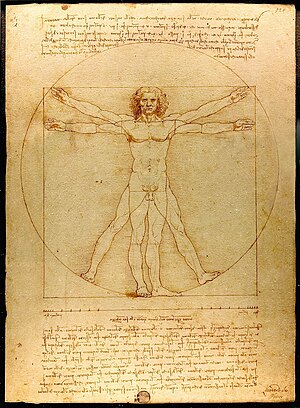
"The Vitruvian Man", drawing by Leonardo da Vinci
 (1490) using pen and ink on paper.

The Vitruvian Man, by Leonardo da Vinci is an example of how the artist would analyse and study form down to it's most minimal formulae, and is modernly still known as a major influence on the way we work in life drawing. The image, depicting the perfect and true proportions of man, is accompanied by a range of codified notes for da Vinci himself. The man inside the square and circle shapes, mixes ideas of both art and science for the divine proportion, setting up the basis of the golden ratio. 

Renaissance Architecture

Mostly under construction in the 15th to the 17th Century, Rennaissance architecture began the revival of Roman and Greek architecture as it spread throughout Europe, only later to revolve into Baroque architecture. The Apollonian features of Renaissance art also resonated throughout it's cities, evident through the importance it placed on symmetry, geometry, balance and proportion. This period saw the return of predominantly Roman features of architecture, e.g. domes, columns and pilasters, this reflected the Classical styles rather than the previously adopted Gothic ideas spread throughout Europe. 

"Cathedral of Saint Mary of the Flower" (Florence Cathedral), Italy, Built in 1436.
The Florence Cathedral is an example of how a dome has been constructed in light of the styles of Roman architecture in particular. The largest brick dome ever to have been constructed, the architects of the building insisted on the rejection of common Gothic buttresses in favour of the Italian Renaissance return to tradition.

East Doors of the Florence Baptistry by Lorenzo Ghiberti, (1425 -1452). 
As with the return of tradition, works by artists and designers would take many years to produce and many artists would only create few masterpieces in their lifetime. An example being Lorenzo Ghiberti (1378 - 1455). Ghiberti was an artist that spent much of his life working on only a few doors for the Baptistry at Florence,

Renaissance Painting

Frescoes or painted murals are a well preserved aspect of Renaissance painting and is relevantly associated with antiquity, examples being in Pompeii and Herculaneum. While new themes of painting became acceptable during this period, particularly the later popular practice of landscape painting as brought into the mainstream by Giovanni Bellini's Madonna of the Meadow painted in 1500, or even Rembrandt's etchings of The Three Trees from 1643. Images like this began to stretch the imagination beyond the classic themes of painting rather than based in pure observation while portrait painting became a vital component of Renaissance art but moved on to a slightly more realist than stylistic quality, beginning to understand tonal value and perspective rather than flat planar views.

As metalwork also became more popular in Germany in the 1430's and paved the way towards goldsmiths using engravings for their trade using a hardened steel tool and ink for bold and deep designs.

Finally, a wider range of media and materials meant that printmaking became possible for artists such as Andrea Mantegna, who was the first artist to beginning producing prints and etchings and single artworks rather than designs.

Renaissance art was a time when the role of the artist flourished and rose to prominence, from Michelangelo, Leonardo, Raphael and Donatello - considered to be the masters of the High Renaissance - to the artists from Venice such as Tintoretto and Veronese. Sanzio Raphael for example is the painter of The School of Athens fresco of 1509.

Mannerism

The latter period of the Renaissance - Mannerism - despite showing an intellectual sophistication and a new style of it's own, saw a decline in the qualities of what we understand Renaissance art to be. The image below The Fall of the Giants by Giulio Romano, completed in 1534 is an example of how this decline began to take shape, the form was less similar to that of the classic Greek and Roman art, despite it's themes. This is due to the lengthened proportions, the beginnings of chiaroscuro and stylization looks more to the art periods to come rather than looking back into the past. 

The Fall of the Giants by Giulio Romano, Fresco started in 1526 and completed in 1534. 

So, ultimately, the Italian Renaissance is probably the richest and most famous period of art history to date and has had the most cultural influence and popularity that can be seen even today. Artists such as Leonardo da Vinci, Raphael and Michelangelo are the most well known and highly regarded in history with works of their art standing the test of time and featured in galleries today. For this reason, the period was highly influential on methods of painting, drawing, etching etc. and by it's end in the 17th Century, paved the way for a fresh way of art making that is moving towards modern techniques and processes.


The Northern Renaissance is a much less complex period of art history in comparison to the Italian Renaissance, lasting for only a century in contrast to the three hundred years of the Italian branch of the movement and spread of art. However, around the same time that Renaissance art was beginning to flourish in Italy, a parallel art movement was taking root throughout Northern Europe. Rather than a "rebirth" the Northern Renaissance was seen as "reinvigorating" the art from the past - working almost exclusively in the new media of oil painting.

Painting Practices

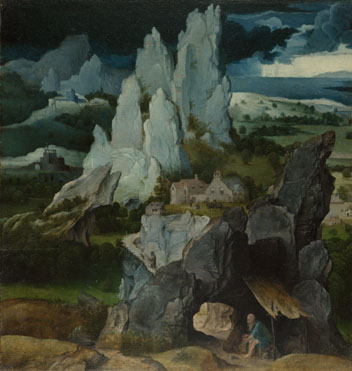
By the time of the Northern Renaissance, art had become independent of it's environment and had become "art for art's sake" rather than used for design or decoration, this began the still common trend of painting using an easel. An example of taking an artwork and creating it away from it's local environment, is St. Jerome in a Rocky Landscape by Joachim Patenier, completed in 1524. This image, along with others by Patenier, depict him as the first artist to embrace the painting of landscapes to be displayed independently from the environment. This allowed for extensive themes within a painting and also encouraged the spread of oil paintings throughout Europe.

"St. Jerome in a Rocky Landscape" by Joachim Patenier, completed
by 1524 with oil on easel painting.
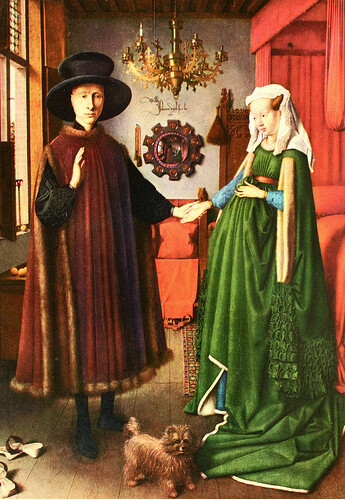
Prominent features of Northern Renaissance paintings are often found in the symbolism and meanings of the finer details, such as parts of domestic objects as paintings focused on a complete scene or composition rather than one specific theme. Paintings such as The Arnolfini Portrait by Jan Van Eyck are filled with hidden meanings, evidence and even allegories such as fertility, the role of women, marriage etc. which can be alluded to even through removed shoes on the floor, the vivid red and green tones and the hidden mirror image in the background. This creates a more dynamic and realistic scene.

"The Arnolfini Portrait" Oil Painting by Jan Van Eyck
completed in 1434.

Oil Painting

The use of oils in order to change painting technique changed the way that we paint, it provided an unprecedented clarity that could not have been achieved by earlier means and made the creation of crisp and vibrant colours easier to produce, paint was now more widely available with access as painters did not have the same difficulty in manufacturing paint. This was particularly highlighted in the work of Jan Van Eyck which alludes to a hyper realism that would not be revisited again for centuries to come. 

Oil painting also allowed for an easier depiction of the effects of light upon detail as shown in the above Arnolfini Portrait which shows an immense clarity in it's observation of the chandelier and light streaming in through the window. Oil paints only serve this method further in his painting Man in a Turban  in 1433. This new application of material by paint meant that the bridge between Northern Renaissance and Baroque was beginning to formulate.

Other key members of the Northern Renaissance period of art include Rogier van der Weyden, considered to be the most influential painter of the time, e.g. a prominent artwork being The Descent from the Cross c. 1435.

In conclusion, the Northern Renaissance provided a different branch of the Renaissance for the Low Countries of Northern Europe. It looked at the finer and more ornate details in a painting and revolutionized the environment and the ease of painting with oil paints and the introduction of the easel, this made it easier for artists such as Campin, Bouts and Memling utilized these materials for their advantage, providing a parallel between the Renaissance and the Northern Renaissance.


The term Baroque was originally used as a critical term in order to insult the movement and discourage artists from painting using it's techniques, claiming it was unnecessarily extravagant and complex in it's features, it is only modernly that it's themes and ideas have become more popular and have been regarded as a form of high art from the 17th Century. It is described as a Dionysian art period.

In society at this time, there was a division of faith between Catholic and Protestant Europe, with the former becoming immersed in the Baroque style of art and architecture. This resulted in such designs as the Palace of Versailles, the fountains in Rome and churches. However, Protestantism aimed to remove the religious connotations in art, whitewashing all interiors and looking forwards to new ideas free from the constraints of Catholicism.

Subjects of Baroque Art

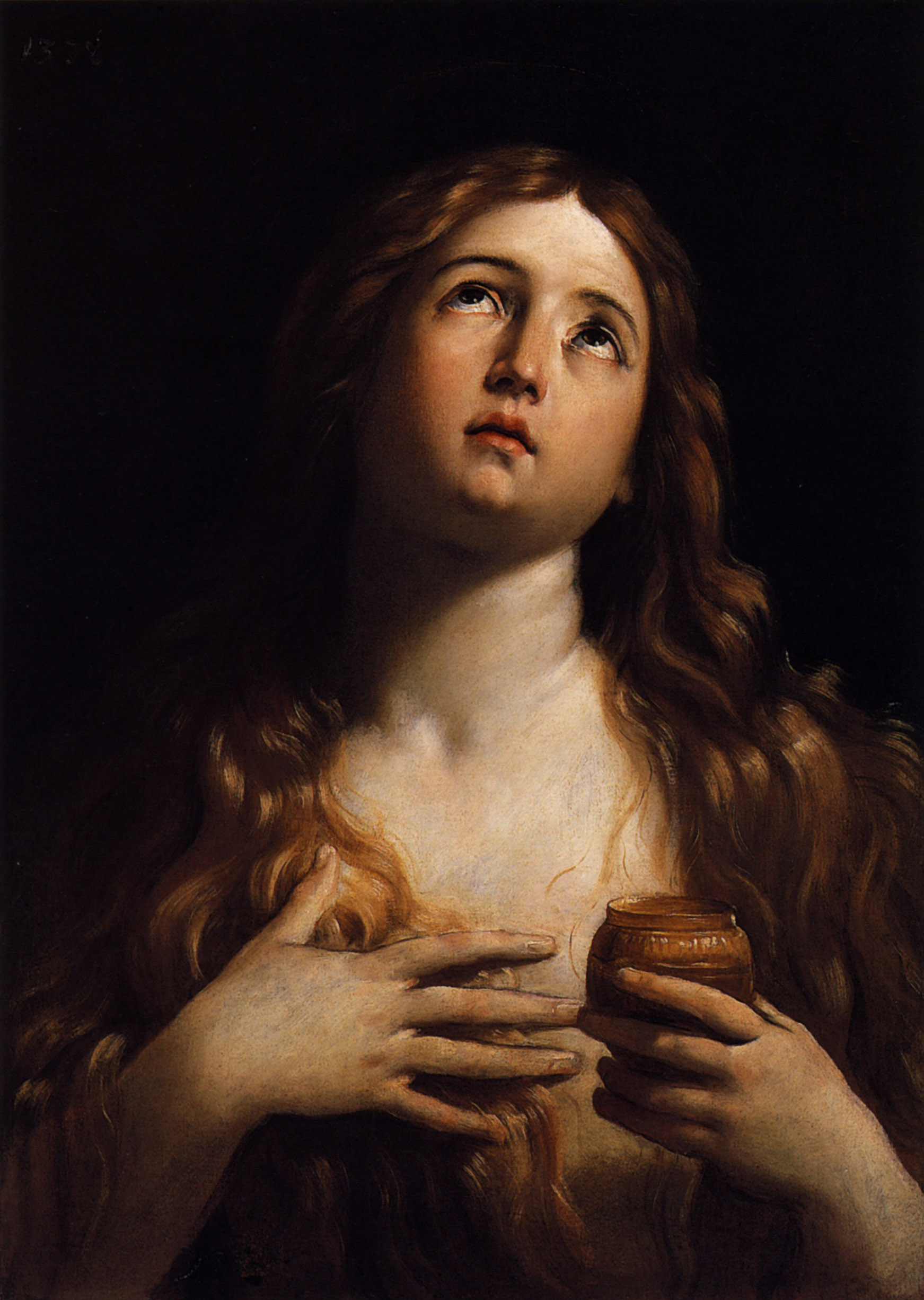
As previously explored, Baroque art featured heavily a return to an extreme sense of religion, focusing on biblical figures, mythological figures and the inclusion of allegorical figures in their paintings as well as more broad themes of chastity, peace faith and modesty. An example of an artist who accentuates these themes is Guido Reni who is known as a Bolognese master, he depicted emotion intensely with highly ornate scenes based on mythology e.g. Lady with a Lapis Lazuli Bowl c. 1630's and St Mary Magdalene c. 1642.

Guido Reni's "St Mary Magdalene" c. 1642.
Michelangelo Merisi da Caravaggio

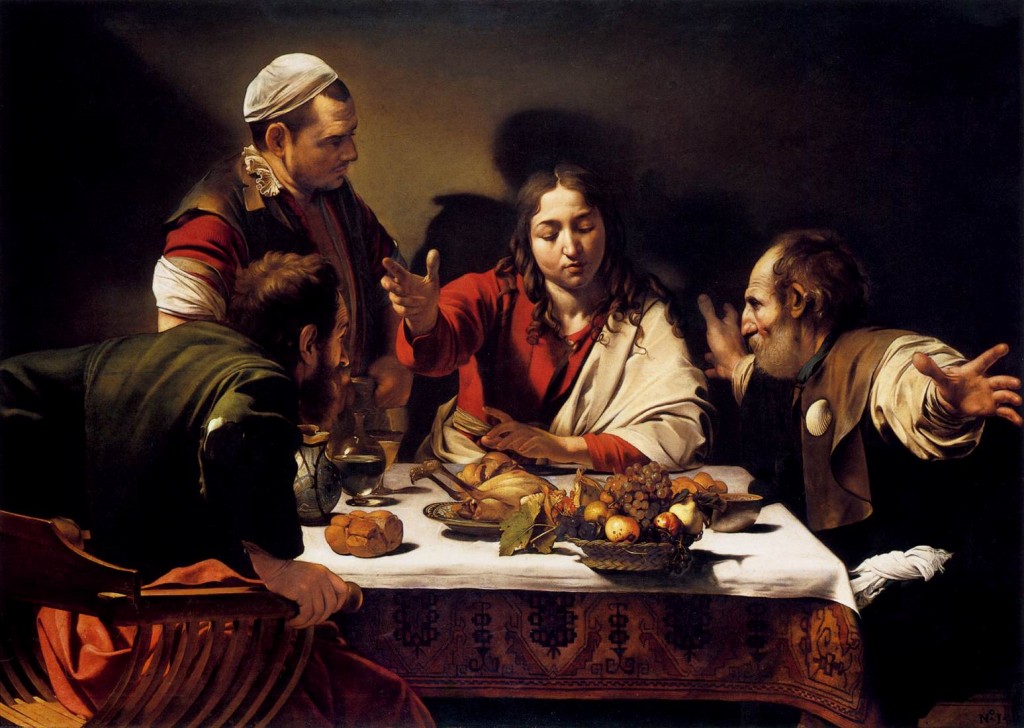
The Milan born artist was the most famous of Baroque artists and the most controversial high profile artist to date, his criminal record haunted by acts of crime and even murder. He was know for his unconventional methods of acquiring models for his paintings. However, despite this his artwork is some of the most influential throughout time.

"The Supper at Emmaus" by Caravaggio, painted in 1601.
The Supper at Emmaus was painted by Caravaggio in 1601 and encompasses everything from the Baroque era, focusing on all the characteristics that add to the dark and grotesque, heavily ornate qualities. It features the lighting of chiaroscuro, the inclusive composition and viewpoint and the sense of movement.

His paintings were often claimed in the 20th Century as using the camera obscura in order to draw the image and was also plagued by rumours that he had been a murderer and fished a prostitute from a river in order to use as a model for one of his paintings.

Chiaroscuro

The technique of chiaroscuro, developed lightly during the Northern Renaissance, that creates a source of light within a scene, i.e. from a candle or unnatural source, illuminating certain sections of the scene and darkening the other tones, looking more at tonal values rather than line. It creates heavy shadows and dingy compositions as shown in the image below.

Georges de la Tour is an artist that used chiaroscuro as a tool in order to achieve light and tonal values. often from candlelight in order to illuminate features closely, his other focus being on peasant scenes using oil paints.

"Mary Magdalene with a Night Light" by Georges
de la Tour, Oil Painting, c. 1635.

Key Artists

Other important artists include Juan Sanchez Cotan, a Spanish painter who was the first, particularly in the Baroque period, to look primarily at still life compositions. It looks at the existence of death, noticable in the way chiaroscuro is used to create a sense of recession into the darkness of the background, making the image appear more sinister with rich colours ascending out of the black. In Still Life with Game Fowl, Vegetables and Fruits from 1602. He named this a bodegon, often using dead plants, animals and rotting food to illustrate his intentions.

"Still Life with Game Fowl, Vegetables and Fruits" by Juan Sanchez Cotan
in 1602.
In conclusion to the Baroque era of art, it looks at a highly stylized form of lighting and tone. It's focused on observation and the combining of people and objects into composition rather than focusing on singular objects it centres around movement and the recession into darkness. Baroque art began as a heavily criticized art period, but by the 20th Century had become important to fine art in accordance with it's painting techniques.

In the period of history leading up to the French Revolution, the Rococo period had superseded the Baroque era and replaced it's darker themes with intricacies, ornamentation and decoration, with the work Rococo meaning "shell work". It focused on beauty and the motif. Being an exclusive art period to the French court, it catered only for aristocracy and was just another example of how the Bourgeoisie became more and more detached from the people as their wealth was put on exhibition through art, particularly attached to the reign of Louis XV.

Features of Rococo art

In the Rococo period, painting was delicate and finely detailed, which would later become criticized despite it's intricate curvilinear shapes and perfect finishing, complete with rich and luxurious fabrics and beautiful backgrounds. In a way, this was the complete opposite of what the Baroque artists were attempting to achieve. However, the marks of a rococo painting are shown in soft brush strokes, reflective of the wealth and royalty of French court.

Key Artists

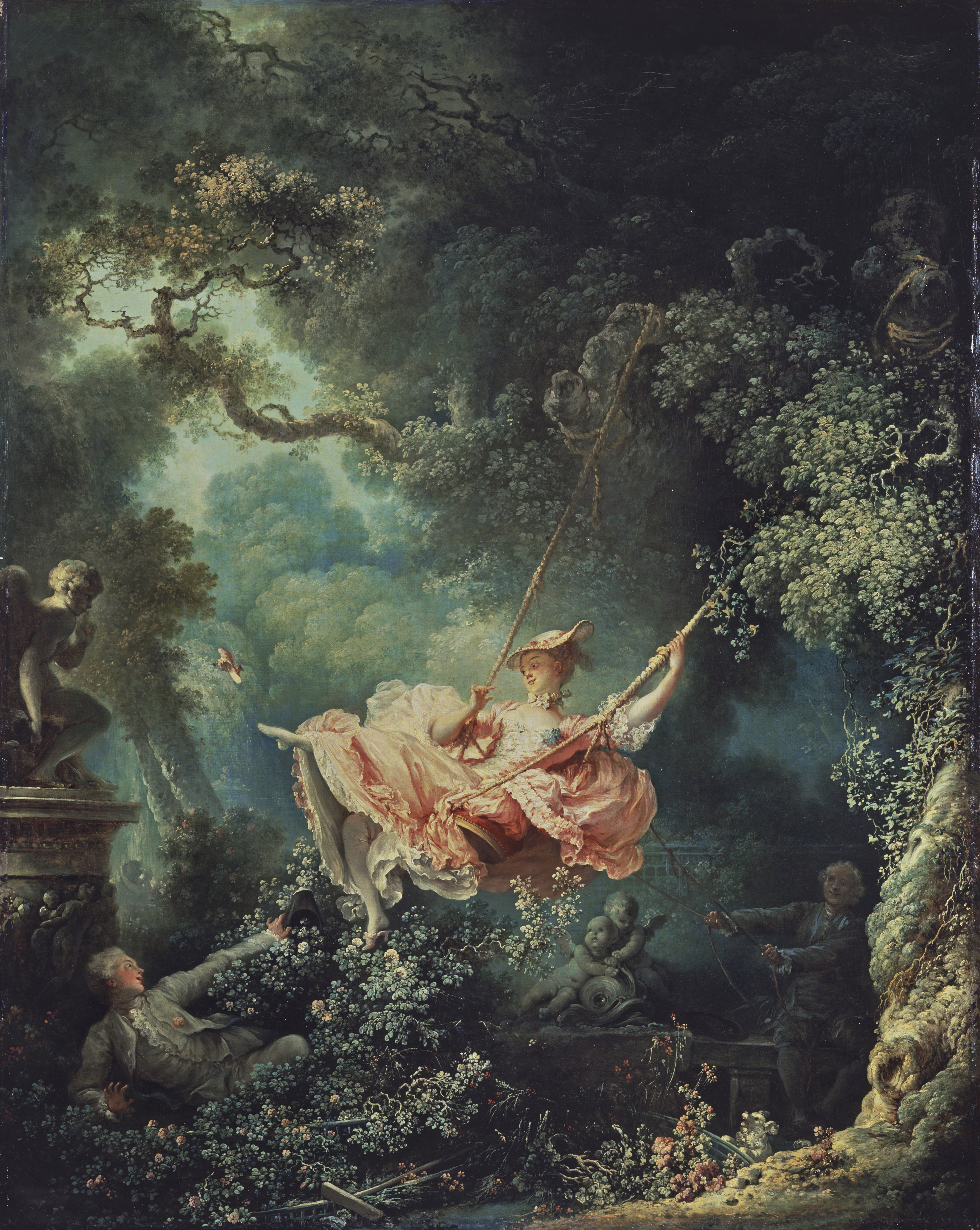
Jean-Honore Fragonard is an example of an artist that would paint the high society of the French court, his most famous work being The Swing (Les hasards heureux de l'escarpolette) painted in 1767 using Oil on Canvas which made him popular with the aristocrats of the court. His figures are prominent in their rosy cheeks, exposed body and 'passionate' embraces as shown in The Swing. This painting shows the lifestyle in which they live, the girl is being pushed on the swing by her husband while her husband sits in front looking up her skirt.

"The Swing" by Jean-Honore Fragonard, Oil on
Canvas, finished in 1767.
William Hogarth

From the Rococo period, William Hogarth became a vital name for his crucial theory on the 'Serpentine Line'. In the William Hogarth book, "The Analysis of Beauty" from 1753. In the book, he describes how the way to fix art would be to stop the "fluctuating ideas on taste". He claimed that the Serpentine Line was of optimum beauty, with nature's observation being the "cornerstone of artistic practice". We should be pleasuring the eye with a sense of variety according to Hogarth. 

How did the Rococo period end?

The French Revolution effectively ended the French rule of Louis XVI and the political climate that Rococo art revolved around. The end of this rule was brought about by revolts that effectively ended the French monarchy and put Napoleon in place. This period of art was quickly marginalized, claimed to be far too based on ornamentation and wealth, very simple and sentimental themes. The art that would later become favoured would be the styles of Neoclassicism and the art that came out of the Age of Enlightenment. Some writers and critics, such as Voltaire, also regarded the period of art as being too superficial and later becoming "degenerate". Neoclassicism would be what replaced Rococo art in France.

"Simplicity" by Jean-Baptiste Greuze (c. 1759).

The degenerative qualities of the Rococo period as seen in the later half of the 18th Century are illustrated in the image above, "Simplicity" by Jean-Baptiste Greuze, painted in 1759. The images theme is purely sentimental and is based on it's emotional value of the young girl rather than the higher regarded portraits of aristocrats such as Madame de Pompadour earlier in the period. The work is vey soft and plain, generating very little interest. Greuze himself has often been accused as an artist of overt emotion, unnatural and poor composition and unattractive colour schemes and palettes.

Ultimately, the Rococo art period of history is one that is closely tied with the society of the time and the political climate, influencing the artwork directly. It's themes do not often differ from the subject matters of wealth, luxury, status, sexuality etc. all aspects of French life being exploited in the court by Louis XV and the monarchy itself. It's criticisms as a movement of art are more wide ranging than most throughout history, from the twisted portrayal of emotion, the lack of dynamic in subject matter and the degeneracy and overall decorative qualities that were later rejected after the French Revolution in 1789 to 1799.


After the rejection of the Rococo period, Neoclassicism aspired to restore the order of Apollonian art and style, marking a return to the ideas and forms found from the Renaissance period, but more importantly, looking back to the classic ideas and themes of painting depicted particularly in Roman Art. This aimed also return to the artistic standards of the ancient world. It's most highly regarded painter is often named as Jacques Louis David, who used ancient scenes as an allegory for contemporary issues.

However, in the 20th and 21st Century, this period of art history is often noted as dull and repetitive, regurgitating the same themes, ideas and compositions without any accompanying fresh ones. This meant that for the most part, this was a familiar form of art that we have seen revived multiple times during history. The Neoclassicists desired to return to the 'pure' art of Rome.

 The Return to the Classic

The majority of neoclassical works are conducted in the media of painting. These paintings would feature the biblical or mythological scenes found from the Ancient civilization. The painting below, The Oath of the Horatii by Jacques Louis David in 1784 is an extraordinarily large painting standing at 3.30 by 4.25 metres. The painting itself aims to depict heroism, revolution and empire as used by the rebels during the French Revolution, despite the painting being commissioned by Louis XVI, Jacques Louis David's work was used for an ulterior purpose.

"The Oath of Horatii" by Jacques Louis David, painted Oil on Canvas, (c. 1784).

In the above painting, links to Classic civilization can be deduced, such as the Roman armour and clothing, involving togas, helmets and swords, the striking shadows casting a difference between the soldiers and the women and children behind, the return of the rich red colour alludes to power, passion and the air of revolution.

Jacques Louis David

(1748 - 1825) David was heavily inspired by politics and was often commissioned to create paintings as an early form of what we would now call propaganda, often providing a commentary on the French Revolution and the rule of Napoleon and the French Empire. His paintings are often deemed to be heroic and dramatic in their emotion, scenes are not subtle or understated but bold. Other works by Jacques Louis David include, The Death of Socrates (1787) and Madame Recamier (1800), mostly working with the media of chalks, drawing and oil painting.

Neoclassical Sculpture

Antonio Canova (1757 - 1822) was a pioneer and the leading participant in the sculpture of the Neoclassical era. He was highly praised as having introduced the revival of sculpture in art since the Renaissance which had largely been abandoned in the Baroque and Rococo period due to the prevalence of the growing art of oil painting, which meant that sculpture had essentially become a "lost art". Neoclassicism was the first period of art to reintroduce this form of media.
Antonio Canova's "Paolina Borghese as Venus Victrix" c. 1805 - 1807
In a similar way to oil and easel paintings during the Renaissance, sculpture had now also become independent from it's environment and was no longer a simple fixture to an architectural design. This meant that sculpture, particularly that of the feminine form, became constructed for art's sake. Another famous work of Antonio Canova was Cupid and Psyche (1796 - 1797) at a height of 150 centimetres, built from marble. This work displays how the sculptor had an obsession for certain areas of the body that others avoided, e.g. hands and fingers.

Key Artists

At this point in time, landscape artistry had become of vital importance. Claude-Joseph Vernet is an example of a painter of beautifully composed Italian landscapes. He often looked at the water, whether it was shipwrecks, ports or coastlines. A typical work of Vernet is The Shipwreck painted by the French painter in around 1772. This is another instance that a relatively contemporary notion or event has been represented allegorically by the painter in order to link back to a biblical or mythological scene, much relevant in the Neoclassic era. The painting is dark in it's colour scheme, with heroic figures saving others from the wreckage, while the sky's background is lit up in places. Critics and contemporaries alike praised Vernet as an inclusive painter, allowing the audience to feel as though they themselves are in the stormy painting.

"The Shipwreck" by Claude-Joseph Vernet, Oil on Canvas, 1772.

Another noteworthy artist of the period was female oil painter, Elisabeth Vigee Lebrun, A member of the French Academy, it was still rare for a female artist to become prominent, however, her painting was reminiscent in aspect of Rococo art, showing surprising similarities due to her being an artist previously under the ancien regime. The similarities lying in the depiction of women's fashion, emotive facial expression, with rich and luxurious colours.
File:Élisabeth-Louise Vigée-Le Brun - Madame Molé-Reymond (1786).jpg
"Portrait of Madame Mole-Reymond" by Elisabeth
Vigee-Lebrun, painted with oil on panel in 1786.
In conclusion, artists of Neoclassicism looked for a return to the "purity" of classic art and it's Apollonian qualities of order, beauty, strength etc. This is a more imperial view on art, adopting the values of both the Ancient Classics and the resurgence during the Renaissance. Qualities admired in Neoclassicism are the heroism, the idealism and power held within the artworks and the narratives they offer. The Neoclassicism era was later superseded by the period named Romanticism. 
In the 19th Century, following on from the Age of Enlightenment of the 18th Century and branching off from Neoclassicism, was the negative reaction to the new developments in science and the effects that the Age of Reason had upon society. Instead of exploring the new themes that looked away from religion to a whole world of new ideas, it looked inward and exploited emotion as a new type of aesthetic, differing throughout the art period in emotions - horror, trepidation and awe, often using these emotions to display their aversion to the Age of Enlightenment. The basic principle of Romanticism was a fusion of natural phenomena and the range of human emotion, looking for an Apollonian sense of subject matter.

Key artists of the period are widely known, ranging from greats such as Francisco Goya to Jean-Auguste-Dominique Ingres, from Eugene Delacroix to Caspar David Friedrich and even John Constable.

Characteristics of Romanticism

Romanticism exclusively explores personal experience and is based on the artists imagination and own emotion. As German painter, Caspar David Friedrich has explained "the artist's feeling is his law." This gave artists a free reign over the subject matter and emotive qualities of their work, whether it achieves wonder, fear, sadness or any other feeling. It was also considered to be vital that every work was unique to itself, this is something that only the best Romanticist painters could provide.

Despite not being fundamental, nature was a key aspect of the paintings, often as a portrait that features a single figure, being affected by their landscape. It was believed that humans needed to maintain a strong connection with nature rather than immersing themselves in the scientific human world. A key artist that achieved this style was Caspar David Friedrich and Wanderer above the Sea of Fog, a painting from 1818 which encapsulates the idea of that human connection with natural phenomena, the figure in the image standing on a mountain's edge looking out over the blanket of fog covering the scene. Although the man's back is turned to the audience, the painting is emotive as it's evident that the character is contemplating his own life and death, looking to the root of Romanticism.

Caspar David Friedrich - Wanderer above the sea of fog.jpg
"Wanderer above the Sea of Fog" by Caspar David
Friedrich, painted in 1818.
Key Artists

Joseph Mallord William Turner is often considered to be extremely influential of Impressionist art, but initially worked in the confines of Romantic art, an artist that truly put himself inside the scenes he created. For the creation of the painting Snow Storm - Steam Boat off the Harbour's Mouth in 1842, Turner even went to the extent of tying himself to the mast of a ship in order to get the experience first hand of the elements of weather and the feeling he was trying to formulate in the painting. One of the more chaotic paintings of Turner's career, the image captured a great deal of emotion and movement despite their being no human figures present in the painting.

Joseph Mallord William Turner ‘Snow Storm - Steam-Boat off a Harbour’s Mouth’, exhibited 1842
"Snow Storm - Steam Boat off the Harbour's Mouth", painted in 1818 by
Joseph Mallord William Turner from a first hand experience of the subject.

Turner and others led to the flourishing of landscape artists in the 19th Century, particularly the work of fellow influential painter John Constable. Constable's landscapes were heavily based on the perspective of nature followed by Romanticists. As an artist, John Constable believed that the aspects of nature; trees, rivers and streams, sunlight and shadow etc. was able to allude to spiritual goodness, creating that connection between us and nature once again. His most famous painting, The Hay Wain painted in 1821 with oil on canvas. As the perspective and emotion of the artist is always law, it was a painting that connected to Constables childhood as the son of a miller and the memory he had of this time. The image puts together so many small components to gain a sense of lifestyle and emotion with clarity. 

"The Hay Wain" by John Constable, painted from overlaid sketches and
oil on canvas, 1821.

Francisco Goya

The mediums used by Francisco Goya were wide ranging, from drawings to engravings and to wall paintings. Themes ranged from portrait to commissioned political artworks with a purpose. One of his most famous artworks is The Third of May, 1808 painted and exhibited in 1814. The image depicts Napoleon's army during the Franco-Spanish War as they execute around a thousand villagers in Madrid in revenge for a rebel attack. His artworks are high emotive, with a sense of horror to establish a feeling on a political or war theme.
goya third of may
"The Third of May, 1808" painted by oil on canvas and exhibited in 1814 by
Francisco Goya.
Goya has also produced many other less well known works which are emotionally and politically motivated with a romantic tone. Goya's etchings and aquatint were extremely relevant, originally commissioned for Spanish court artworks, his own personal work gave way for him to express more of his own views, e.g. The Disasters of War (1810 - 1820) as he recorded his own imaginings of the Napoleon invasion of Spain in 1808 and it's atrocities, barbarism and heroism. 

"The Disasters of War", an etching of a series by Francisco Goya, (1810 - 1820)
The etchings are one of the fewer examples of how the emotion of horror can be depicted in Romanticism, it relies on a very different kind of media to other artists during this period, making Goya stand out as one of the best and most important artists of the 19th Century.

Ultimately, Romanticism as an art movement that is a rejection of anything discovered in the Age of Enlightenment, furthered by landscape artists such as John Constable and J.M.W. Turner as well as other artists including Francisco Goya, Caspar David Friedrich, Eugene Delacroix etc. It sees the beginning of the celebrated relationship between human nature and emotion and nature of the world around us, often resulting in idealistic imagery of an Apollonian nature or Dionysian disorder, war etc.

Academic Art was the period in history in which official institutions were set up in order to both teach and exhibit art that was favoured by the schools for using the techniques and processes celebrated by such Academies. In the 19th Century, institutions such as The Paris Salon, the Academie des Beaux-Arts set up in 1725 were the hub for Academic Art in Europe up until the 1890's. In 1863, the Salon des Refuses was the institution set up as a reaction to the work that was rejected from the Paris Salon, exhibiting the more unconventional and controversial side of the art period.

The introduction of Academic art meant that art was now made into an industry itself, with exhibition of art really beginning to take off, this meant that prospective artists were submitting their with the purpose of recognition and criticism. This changed the landscape of European art up until the current day, changing the way in which art became accessible to the public eye. However, Academic Art is largely known for the masterpieces it rejected, with these artworks being the most famous now, rather than artworks the Salon accepted.

Characteristics of Academic Art

Characteristics of Academic art and therefore taught by the Parisian schools which lie within the mediums of sculpture and oil paintings. all of which looking to portray technical and intellectual skills, an Apollonian ideal. They all displayed ideas and subject matter that spanned through Neoclassicism, Romanticism and later on, Impressionism. These qualities can be found in the work of artists such as Paul Delaroche and Thomas Couture.


"The Execution of Lady Jane Grey" by Paul Delaroche, painted in 1833 using
Oil on Canvas.
The painting above, by painter Paul Delaroche, as common to the period, depicts a historical scene of the beheading of Lady Jane Grey, a well known point in history. It also appears to focus on the Romanticism of the scene, focusing on the figures around her rather than on Lady Jane Grey herself, paying attention to their emotions. It shows very technical skills and abilities in it's painting and has been a major exhibit at the Salon.

The Paris Salon

The Parisian Salon was an art exhibition space, opened in 1677, becoming particularly popular in the 19th Century. The space was reserved for students of the Academie des Beaux-Arts, with artworks judged and qualified for the exhibition based on their skills.

A major quality of The Salon that made it recognized and distinguishable from modern day art galleries is the sheer mass of artworks it exhibited, the walls of it's rooms were filled inch-by-inch with students paintings, from floor to ceiling. The Paris Salon was filled with artworks such as Thomas Couture's The Romans of The Decadence from 1847 and William Adolphe Bouguereau's Birth of Venus from 1879.
William Adolphe Bouguereau's "The Birth of Venus",
painted by oil on canvas, 1879.
"The Birth of Venus" as painted by Sandro Botticelli,
1486.
The image above, Bouguereau's Birth of Venus, painted in 1879, is an example of how the students at the Salon would look back to previous artworks from more Apollonian art periods, such as the Renaissance, and imitate or even copy the subject matter or techniques by applying their own techniques. For instance, Bouguereau's own rendition of the Birth of Venus is an imitation of the painting of the same name by Sandro Botticelli. When compared, it can be noticed that the image on the left, from the Academic period, is painted with thicker brushstrokes, using impasto technique, it is more realist in it's painting and focuses more on skills than the subject matter. The Renaissance painting on the right, however, is more stylized and painted with the mythology in mind. 

Royal Academy of Arts

Founded by Joshua Reynolds, under King George III, the Royal Academy of Arts, London is an art school built in 1768 in hopes of promoting the cause of professionalism in the arts and design industry. The image below, taken in the 21st Century shows how popular the galleries at the Royal Academy still are. Similarly to the Paris Salon, paintings still cover a large proportion of the wall space. 
Galleries at the Royal Academy of Art, London for the 2011 Summer Exhibition.
Johann Zoffany's "The Academicians of the Royal Academy" (1771 - 1772).
The image above gives us an insight of the studios of the Royal Academy, showing the room filled with people and two life models to the right, it bares some similarities to art schools in the 21st Century even, showing the model at which art schools following on from this were built upon. The painting itself is constructed in the way of much Academic art, showing how sculpture was included in Academic art as students started to learn to paint their own surroundings.

The Salon des Refuses

Many artworks were rejected by the Paris Salon, much of these were turned away due to their unconventional techniques or subject matter. Many of the rejected works were then found by an establishment built in reaction to the Salon's system, named the Salon des Refuses. The Salon des Refuses was constructed in 1863 after many artworks that year had not been exhibited.

Edouard Manet - Luncheon on the Grass - Google Art Project.jpg
"The Luncheon on the Grass" by Edouard Manet from 1863's Salon des Refuses.
The image above, The Luncheon on the Grass by Edouard Manet was a key image in the Salon des Refuses existence. It was an image based on a painting by an Old Master, but it's subject matter was considered unacceptable by the Salon. This was the reason for the Salon des Refuses. The casual nude female form was too controversial while painting men fully dressed. There was a similar negative reaction to Olympia, painted in 1863. This painting was thought to include a reclining nude of a prostitute with a black woman as a maid, this was thought to also be unsavory and was subsequently added to the Salon des Refuses.

Other Key Artists

Other artists included in the Academic era of art attended a variety of high profile art schools, with many people migrating across Europe and from beyond. One of these artists is Frederic Edwin Church. Church has been considered to be one of the greatest American landscape painters in history. His observations for such landscape paintings took him to both the North and South Americas to record natural phenomena in a Romanticist style. Using a new elevated viewpoint and distant horizon, he was a major figure that attended the Hudson River school for landscape painting. One of his most important works was Aurora Borealis painted in 1865, depicting the Northern Lights phenomena with an observation close to photo-realism, paying close attention to light and tonal value.
Aurora Borealis by Frederic Edwin Church
"Aurora Borealis" by Frederic Edwin Church, painted with Oil on Canvas in 1865.
Another important artist during this period was another American artist, Thomas Cole. The founder of the same school as Church, Cole taught at the Hudson River School. Cole was conservative in his understanding of Academic art and Romantic in his painting style. His landscape painting was mixed with a subject matter that overlapped with mythology and biblical ideas. 
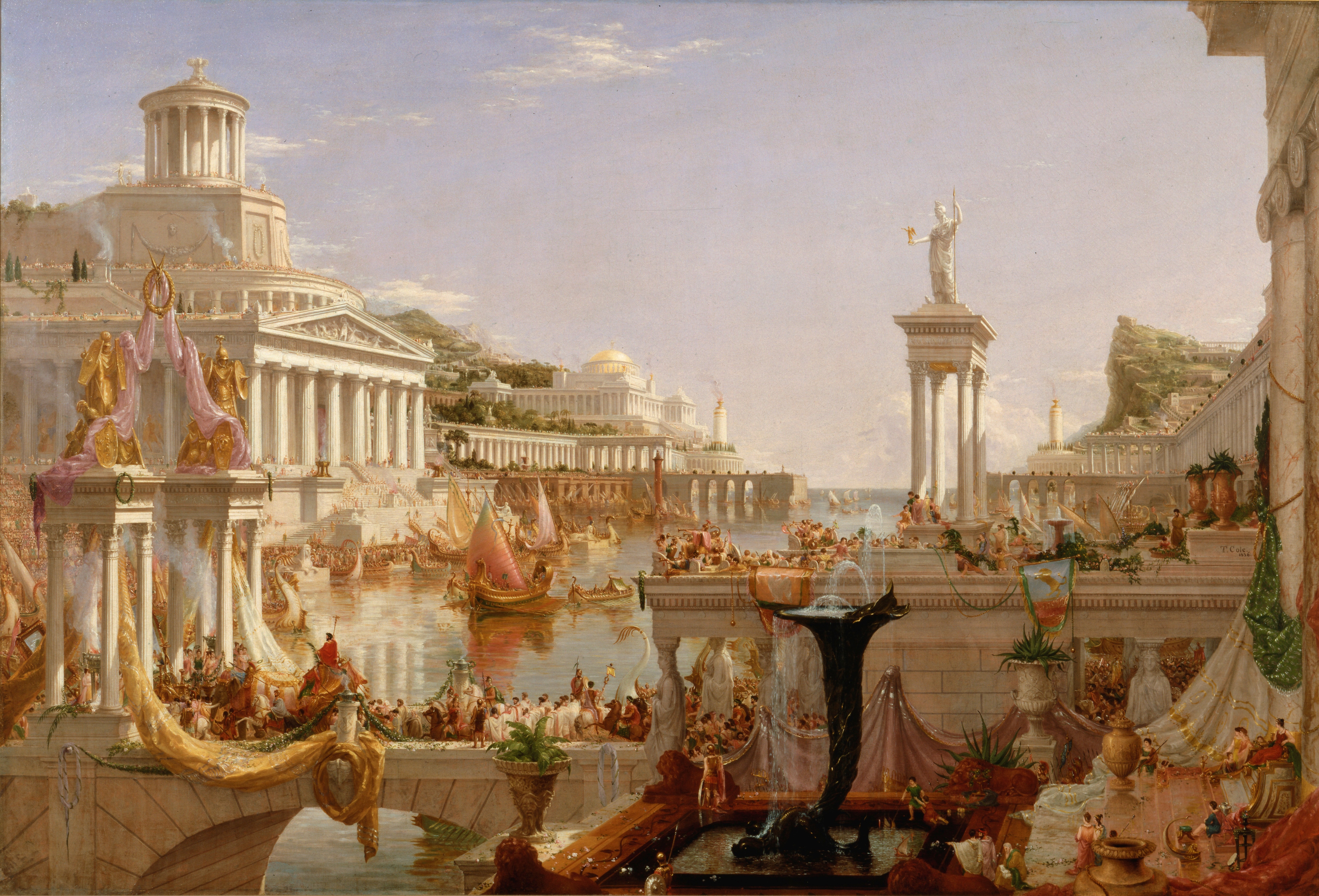
"The Course of Empire" by Thomas Cole, 1836, painted by Oil on Canvas.

The Course of Empire by Thomas Cole symbolises the way in which Academic Art was still stuck in the past, imitating the art and landscapes of the Greek Empire and other historical scenes.

To conclude, Academic art is a culmination of the past and skills acquired from traditional means of oil painting, brush marks, perspective etc. The field of Academic art in history proves the competitiveness that is rife in the European art world, however, despite institutions such as the Royal Academy, the Hudson River School and the Salon, it is it's reactionary movement found in the Salon des Refuses that defines the 19th Century of art, through it's ground breaking subject matter. This put artists such as Manet on the map and changing the way we move through art history.